

Anchor days: Do they actually improve team collaboration?
Anchor days promise better collaboration by getting teams in the office together on set weekdays, but they often create new problems like overcrowded Tuesdays, back-to-back video calls, and frustrated employees who commuted for nothing. This guide explains how anchor days actually work in practice, when they deliver real value versus when they backfire, and how to design a policy that people want to follow instead of resent.
What are anchor days in hybrid work?
Anchor days are specific weekdays when your team agrees to work from the office together. This means everyone knows exactly when their colleagues will be onsite, making the office a predictable place for collaboration rather than a gamble.
Unlike fully flexible hybrid setups where employees pick any day they want, anchor days create structure. You might decide that your team comes in every Tuesday and Thursday, for example. This removes the guesswork about whether your commute will be worth it.
Most companies pick mid-week days like Tuesday, Wednesday, or Thursday. These days align with how people naturally think about their work week. Mondays feel like ramp-up days, and Fridays feel like wind-down days, so the middle of the week becomes the collaboration zone.
The core idea is simple: if you are going to commute, your team should be there too—Microsoft research found 73% would come in more frequently if they knew their team members would be there. Without this coordination, you end up with empty offices and frustrated employees who drove in for nothing.
Do anchor days work, and when are they worth it?
The short answer is that anchor days work when there is a clear reason to be together. They fail when they become attendance theater, where showing up matters more than what you actually do.
Success depends entirely on how you use the time. If your anchor day looks identical to a remote day except you are sitting in a different chair, the policy will breed resentment fast.
When anchor days succeed:
- Cross-functional projects: When multiple teams need to solve problems together in real time, being in the same room cuts through hours of back-and-forth messages.
- Onboarding new hires: Junior employees learn faster when they can observe senior staff and ask questions on the spot.
- Creative work: Brainstorming sessions and strategy discussions often flow better when everyone can see body language and energy levels.
When anchor days backfire:
- No planned collaboration: If people commute just to sit on video calls all day, they will question why they bothered.
- Rigid rules for focused roles: Developers, writers, and analysts often need quiet time for deep work. A noisy office on anchor days can destroy their productivity.
- Forced socializing: Mandatory team lunches or "fun" activities can feel like pressure rather than connection.
The metric that matters is not badge swipes. It is whether your team feels more aligned and connected at the end of the week.
What problems do anchor days solve for teams and HR?
Anchor days address specific pain points that unstructured hybrid work creates. The biggest problem they solve is coordination chaos.
Without set days, employees often show up to empty offices. They miss the exact colleagues they wanted to see, which makes the commute feel pointless. This creates a cycle where fewer people come in because they assume no one else will be there.
Core problems anchor days fix:
- Unpredictable attendance: You never know who will be in the office on any given day, making it hard to plan meetings or collaborative work.
- Culture erosion: Fully remote teams can lose their sense of shared identity. The informal conversations that build trust and transfer knowledge disappear.
- Space planning guesswork: Facilities teams cannot predict demand, leading to wasted money on heating empty floors or running out of desks on busy days.
- Manager visibility concerns: Leaders worry about team cohesion when they rarely see their direct reports in person.
Anchor days give HR and workplace teams a framework. They balance employee flexibility with business needs for collaboration and culture. Tools like deskbird's Week Planning feature make this coordination automatic by showing who will be in the office before you commit to a day.
The anchor day paradox and common problems
Here is the paradox: companies roll out anchor days to boost collaboration, but they often get the opposite result. This happens when the policy exists without changing how the office actually works.
The most common failure is what people call "Zoom from office syndrome." Everyone commutes in on the same day, but they spend the entire time on video calls. This happens because half the meeting attendees are in other locations, or because no one thought to book a meeting room.
Another problem is meeting overload. Managers stack all their 1:1s and team syncs on anchor days, leaving zero time for the spontaneous conversations the policy was supposed to create. Employees end up in back-to-back meetings from 9am to 5pm, then commute home exhausted.
Deep work also suffers. Knowledge workers lose their most productive hours to commutes and office noise. If the office is too loud or chaotic, they cannot focus on complex tasks that require sustained attention.
Capacity becomes a nightmare too. Offices designed for flexible attendance suddenly overflow on anchor days. Desks run out, meeting rooms are double-booked, and the noise level makes everyone want to leave.
These problems are fixable, but they require intentional design. You cannot just mandate a day and expect collaboration to magically happen.
Step-by-step: How to run anchor days people actually want to attend
Running successful anchor days requires more than a calendar invite. You need a strategy that respects employee time and makes the office worth the commute.
Set a clear purpose for in-person time
Every anchor day needs a reason beyond "the policy says so." When employees understand why they are coming in, they participate willingly instead of grudgingly.
Define what activities belong in person. This might include team retrospectives, project kickoffs, milestone reviews, or 1:1s between managers and direct reports. Social events like team lunches or learning sessions also work well.
Communicate this purpose clearly. When your team knows that Tuesday is for collaborative problem-solving and not just attendance, the entire dynamic shifts. People show up ready to engage rather than resentful about the commute.
Choose anchor days that avoid a Tuesday-Wednesday-Thursday traffic jam
Most companies default to mid-week days without thinking about the consequences. This creates massive overcrowding on Tuesday, Wednesday, and Thursday—XYSense research shows 80-90% utilization for conference rooms on these peak days—while the office sits empty on Monday and Friday.
This pattern hurts everyone. Employees fight for desks and meeting rooms on peak days. Facilities teams waste money heating and cooling empty floors on off days. The office becomes unpleasant exactly when it should be most valuable.
Strategies to balance attendance:
- Stagger by team: Have Engineering come in Tuesday and Thursday while Sales comes in Monday and Wednesday.
- Use attendance data: Look at your current patterns to identify which days are already less crowded.
- Alternate weeks: If space is tight, consider having different departments rotate their anchor days across weeks.
Workplace leaders can use deskbird's Workplace Analytics to spot these patterns. The data shows exactly which days are over capacity and which are underutilized, letting you rebalance the schedule based on reality rather than guesswork.
Fix the Zoom from office problem with meeting rules
Anchor days fail when calendars fill with virtual meetings. It is demoralizing to commute 45 minutes just to spend 6 hours on video calls with people who are not even in the building.
You need specific rules to protect in-person time. Block anchor days for face-to-face collaboration only. Move recurring status updates and standard video calls to remote days. Consider a "no internal meetings before 10am" rule so people can settle in and focus after their commute.
These rules require leadership buy-in. If executives spend their anchor days on video calls, everyone else will follow that example. Leaders need to model the behavior they want to see.
Make it easy to find desks and rooms near the team
Employees lose motivation fast when they arrive and cannot sit near their team. If finding a desk takes 20 minutes, the day starts on a bad note.
The logistics of hybrid work create real friction. Without a booking system, people wander around looking for space. They might end up on a different floor from their team, defeating the entire purpose of the anchor day.
How desk and room booking solves this:
- Visibility before committing: Employees see who else is coming before they book their own day.
- Team neighborhoods: Groups can reserve a specific zone to ensure they sit together.
- Room management: Booking prevents double-booking and last-minute scrambles for meeting space.
deskbird's desk booking and room booking features handle these logistics automatically. Employees can see their team's location and book a nearby desk in seconds, all from Slack or Microsoft Teams.
Measure attendance and space usage, then adjust
Your anchor day policy should evolve based on real data, not assumptions. You cannot improve what you do not measure.
Track actual attendance versus planned attendance. Are people showing up when they say they will? Look at no-show rates on booked desks. If desks are reserved but empty, your policy has a problem.
Check meeting room utilization on anchor days compared to other days. If rooms sit empty, people are not using the office for collaboration. Survey employees about whether the commute felt worth it.
If the data shows anchor days are not delivering collaboration, adjust the policy. Do not double down on a failing strategy. Iterate based on what you learn.
Anchor day policy and enforcement without badge-swiping games
Policies only work when they feel fair. If employees feel like they are being watched and judged, trust erodes fast.
Set swap rules that work for real life
Life happens. Children get sick, cars break down, and appointments pop up. A rigid policy that demands attendance on a specific day regardless of circumstances breeds resentment.
Allow employees to swap their anchor day within the same week when needed. If someone misses Tuesday, let them come in Thursday instead. This maintains the volume of in-office time without the rigidity.
Flexible policies encourage compliance because they treat employees like adults. When people have some control over their schedule, they are more likely to honor the spirit of the policy, reducing quit rates by one-third.
Explain enforcement so people do not game attendance
Some employees will try to game the system. They might badge in and leave immediately, or book desks they never use to appear present.
This usually happens when the purpose of the office is unclear. If people do not understand why physical presence matters, they will find workarounds.
Best practices for fair enforcement:
- Communicate expectations upfront: Be clear about why being physically present matters for your team's work.
- Identify patterns, not incidents: Use check-in data to spot chronic issues, not to punish one-off situations.
- Have human conversations: Address non-compliance through manager discussions, not automated penalties.
deskbird's features give you transparent attendance tracking, allowing you to get the data to have informed conversations without resorting to surveillance tactics.
Handle reasonable adjustments and privacy expectations
Some employees have legitimate reasons for different arrangements. This includes disabilities, caregiving responsibilities, or neurodivergent needs that make busy offices difficult.
Build exceptions into your policy from the start. Create a clear process for requesting accommodations. Keep individual medical or personal reasons private. Focus on outcomes and performance, not just presenteeism.
Privacy-conscious companies need tools that respect user data. deskbird is built with ISO 27001 certification and GDPR compliance, so you can track necessary patterns without invasive monitoring of individuals.
How deskbird supports anchor days
Implementing anchor days requires the right infrastructure. deskbird acts as the operating system for your hybrid office, making coordination simple for employees and transparent for management.
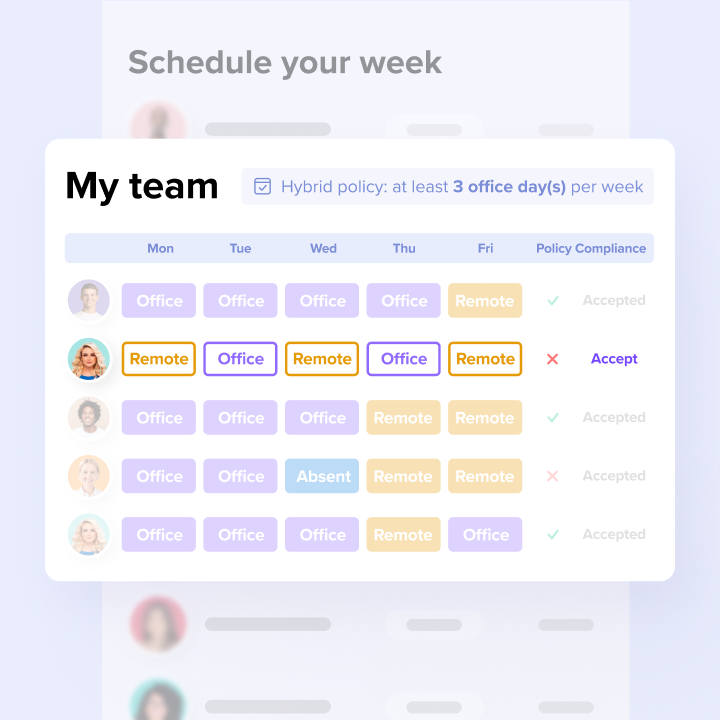
The Week Planning feature solves the biggest friction point: knowing who will be there. Employees see their team's schedule at a glance. They can spot when their favorite colleagues are coming in and book a desk nearby in seconds.
On anchor days, space is at a premium. deskbird helps you manage this demand through desk and room booking. You can assign team neighborhoods so departments always have space together, preventing the frustration of arriving to a full office.
The analytics give you the data you need to right-size your policy. You see exactly which days are over capacity and which are underutilized. This lets you adjust anchor day schedules to balance the load, saving on real estate costs while improving the employee experience.
By integrating directly with Microsoft Teams, Slack, and Outlook, deskbird fits into the tools your team already uses. There is no separate app to remember or new system to learn.
A simple rule for anchor days that work
Anchor days succeed when the in-person experience is worth the commute. That is the simple rule.
If an employee leaves the office thinking "I could have done all of this from home," your policy needs work. The day should feel different from a remote day in meaningful ways. Start small: pick one or two days, measure the attendance and the sentiment and listen to your team. The best hybrid policies are not set in stone. They evolve with the needs of the business and the people who power it.
Ready to make anchor days actually worth the commute? Book a demo.

Frequently Asked Questions
What is the difference between anchor days and mandatory office days?
Anchor days focus on team coordination and collaboration, while mandatory office days often emphasize attendance for its own sake. Anchor days are typically set at the team level based on when collaboration is most valuable, whereas mandatory days are usually company-wide policies that apply to everyone regardless of role or workflow needs.
Can different teams within the same company have different anchor days?
Yes, and this is often the better approach. Different teams have different collaboration needs and workflows. Letting teams choose their own anchor days based on project requirements also helps spread office attendance throughout the week, reducing overcrowding on peak days.
How many anchor days per week should a hybrid team have?
Most hybrid teams find that 2-3 anchor days per week strike the right balance between collaboration and flexibility. Fewer than 2 days makes it hard to build team cohesion, while more than 3 days starts to feel like a full return to office and reduces the flexibility that makes hybrid work attractive.
How do you handle anchor days when team members work in different time zones?
For distributed teams, anchor days may need to focus on overlapping hours rather than full days. You might designate specific time blocks when everyone is available for synchronous collaboration, while allowing flexibility around those core hours. Some teams also rotate anchor days to share the burden of early or late meetings across time zones.
What should you do if employees consistently skip anchor days?
First, understand why they are skipping. If the office experience is not delivering value, the problem is the policy, not the people. Have direct conversations to identify barriers like commute challenges, childcare conflicts, or lack of meaningful collaboration. Adjust the policy based on feedback rather than adding stricter enforcement.
Make anchor days worth the commute
- Let teams see who’s coming in and book desks nearby in seconds
- Avoid peak-day chaos with real-time space and attendance insights
- Measure what works, then adjust your policy without badge-swiping games
