Compare deskbird vs Envoy
Compare features, pricing and use cases of these two workplace management platforms and see why deskbird wins for hybrid teams.

Quick verdict
Envoy is a strong choice if visitor management and front-desk workflows are your primary need. deskbird is built for hybrid workplace teams that need desk and room booking, attendance management, real-time analytics, and workplace operations in one EU-hosted platform.
The key difference: deskbird's adoption-first design means employees actually use it, which means your utilization data is reliable, which means you can make real space decisions with confidence.
Key differences between deskbird and Envoy
deskbird and Envoy are both workplace management platforms, but they solve different problems. Envoy started as a visitor management tool and has expanded into desk and room booking, priced as a separate add-on module. deskbird was built from day one for hybrid work teams: desk booking, room scheduling, attendance planning, analytics, and workplace operations in one connected system, one price.
The clearest signal of which fits your needs: if your main challenge is managing who comes through the lobby, Envoy is strong. If your challenge is helping employees coordinate hybrid days, managing attendance targets, and giving workplace leaders reliable data to reduce real estate costs, deskbird is the better fit.
Key differences:
- Check-in accuracy: deskbird uses geofencing, QR codes, and automatic sensor-free check-in via deskbird Dock for reliable occupancy data. Envoy's Reservations module relies on booking plus at-the-door tablet check-in, with auto-release for no-shows.
- Workplace operations: deskbird includes Workplace Ticketing for facility issue tracking. Envoy has a basic delivery and issue log but no dedicated operations layer.
- AI approach: deskbird's Agentic Workplace automates the admin work behind the platform, onboarding, floor plan digitization, bulk changes, and connects to Microsoft Copilot, Claude, ChatGPT, and Gemini. Envoy offers an MCP server ("AI for Envoy") so external AI assistants can interact with its platform, an interoperability layer rather than a built-in assistant.
- Attendance management: deskbird supports attendance rules, manager approvals, and office-day targets.
- EU compliance: deskbird is ISO 27001 certified, SOC 2 Type II audited, and hosted in Germany with GDPR compliance. Envoy holds SOC 2 Type II but is U.S.-based, which can add data processing agreements for EU deployments.
- Pricing model: deskbird uses per-user pricing from €2.75/user/month. Envoy prices each module separately on top of a required platform fee: Reservations at $5/resource/month (billed annually), Visitors from $109/location/month, Screens at $12/device/month, and Emergency Notifications at $2/user/month, costs that compound as you add modules and locations.
deskbird vs Envoy: an overview

Envoy
Detailed feature comparison
Features available
Why teams choose deskbird over Envoy

Real occupancy data
Geofencing, QR, and automatic sensor-free check-in via deskbird Dock yield more accurate data that lead to better insights and smarter space decisions.

Enterprise-grade integrations
Integrates with HRIS, not just calendars. Auto-provisioning eliminates IT busywork and supports daily workflows.

Hybrid coordination
deskbird supports attendance policies and approval workflows, not just basic booking rules.

EU-first security
Securely hosted in Germany with ISO 27001 certification and explicit GDPR compliance.
Both have great G2 ratings, but deskbird wins
Features available
How does deskbird's desk booking compare to Envoy?
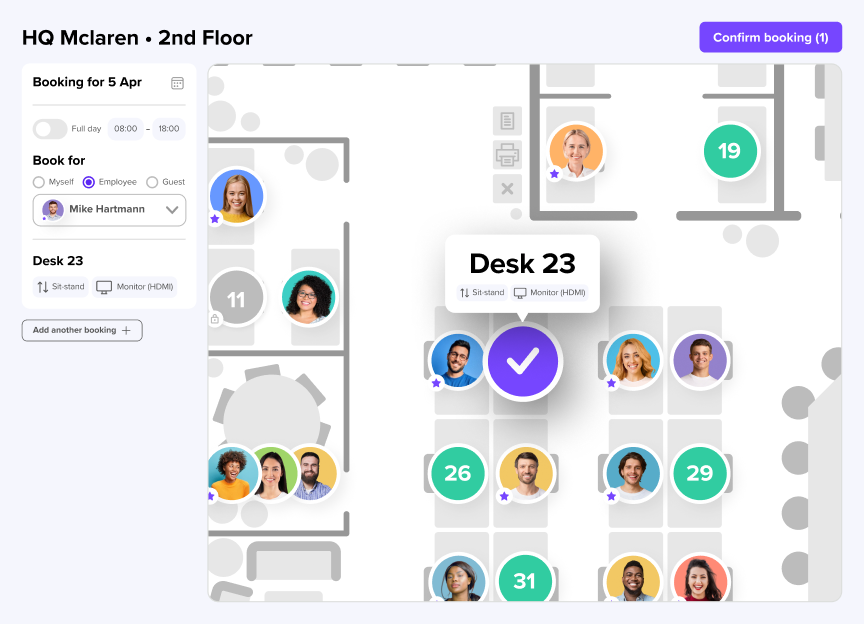
Envoy's desk booking is functional but transactional, priced as an add-on module rather than a core part of the platform. deskbird's approach to desk booking is one of its core strengths: intuitive and fast, letting you book knowing who's coming in on which days and seeing real-time availability on interactive floor maps. Filter by equipment, save favorites, and set up recurring bookings.
Adoption fueling workplace decisions
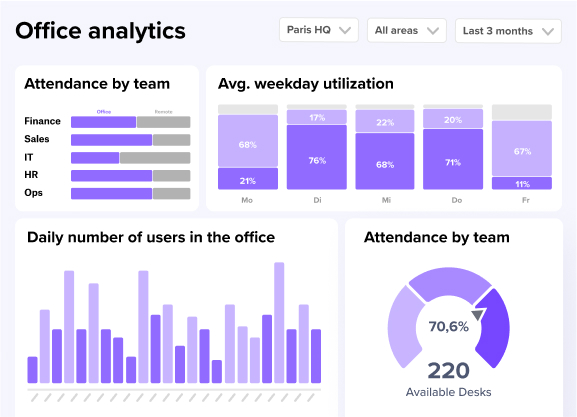
Most office utilization data is unreliable because employees don't use the tools consistently. A booking system with 40% adoption gives you only 40% of the picture. deskbird's 90%+ adoption rate is the reason its workplace analytics are actionable. When most of your team books through the platform, you see real peak days, real no-show rates, and real zone utilization, not a partial sample.
That data feeds decisions: which floors to close on Fridays, when to adjust cleaning schedules, whether you need as much space as you currently lease.
Does deskbird supports hybrid work policies?
Yes. deskbird supports hybrid attendance management, not just tracking. You can set office-day targets, configure team-based attendance rules, and trigger automatic alerts when targets aren't met. Managers get dashboards showing attendance adherence across the organization. Envoy tracks who showed up and when but doesn't run structured attendance workflows or approval rules on top of that data.
deskbird is incredibly easy to use and quick to implement. The user interface is clean and intuitive, so our team had no trouble adapting to it. Booking desks, checking who’s in the office, and managing our hybrid schedules has become much more organized. The setup process was smooth, and the customer support team was responsive and helpful throughout.
deskbird has native integrations that fit a hybrid workflow
deskbird integrates with Slack, Teams, Google Calendar, and Outlook, and adds deep HRIS connections (SAP, ADP, Personio). deskbird also supports SAML/OIDC single sign-on and SCIM, while the open API architecture means it plays nicely with your entire tech stack, HR, IT, calendars, and collaboration tools, without creating integration silos.
deskbird leads in data regulation & security
Both infrastructures are SOC 2 Type II audited and ISO 27001 certified. deskbird goes a step further: built and hosted in Germany with explicit GDPR compliance, it's the default choice for European organizations or those handling sensitive employee data under strict regulatory frameworks. If you're operating across multiple geographies, for example with offices in both the United States and Europe, deskbird's EU-hosted infrastructure ensures data residency requirements are met without workarounds.
Envoy's U.S.-based infrastructure may require additional data processing agreements for European deployments, potentially adding complexity and legal overhead.
How does pricing for deskbird and Envoy compare?
Envoy prices in separate modules, each on top of a required platform fee that isn't published on its main pricing table. Reservations (desks, rooms, parking) runs $5 per bookable resource per month, billed annually, around $60/resource/year. Visitors starts at $109/location/month, with Premium and Enterprise requiring a custom quote. Screens (digital signage) runs $12/device/month, and Emergency Notifications $2/user/month, both billed annually and both on top of the platform fee. For a multi-location office running several modules, that adds up fast and isn't easy to estimate from the pricing page alone.
deskbird offers transparent, per-user pricing starting at €2.75/user/month (annual) or €3.50/month (monthly), including room bookings, visitor management, and hybrid working features. deskbird delivers stronger long-term ROI by improving in-office presence and reducing operational complexity as teams and offices grow.
Beyond upfront platform costs, a few hidden costs are worth considering:
- Admin overhead: How much time does user management and implementation take?
- Adoption risk: If the tool is hard to use, people won't use it
- Integration effort: Custom work to connect with existing systems
- Reporting gaps: Manual work to get the data you want
Can you use both deskbird and Envoy together?
Yes. Some organizations with multi-site HQs and receptions handling high visitor volumes at the front desk run Envoy for visitor check-in and badge printing but need stronger hybrid coordination across floors. They use deskbird for everything else: desks, rooms, office attendance, and analytics.
Running both adds cost and complexity, so it's worth asking whether one platform can cover your needs. If visitor management is secondary, deskbird's built-in visitor management features may be enough.
deskbird or Envoy: which is the best workplace management system for your team?
The right choice depends on what you're actually trying to fix. If your main challenge is hybrid coordination, helping employees find desks, reducing booking conflicts, and understanding how space gets used, deskbird fits that job.
Despite Envoy's strength in visitor management, many organizations find that reliable hybrid workplace software like deskbird covers visitor basics well enough, while delivering the utilization insights that justify real estate decisions, at one predictable price instead of stacked modules.
Disclaimer
Software listed in this article, and corresponding pricing and functionalities, are based on publicly available information as of August 2026 and are subject to change. Information provided without guarantee. If something is mapped out incorrectly, please contact us.
One platform. Your entire workplace ecosystem.
deskbird combines effortless desk and room booking with real-time team coordination, analytics, and hybrid attendance management.
Schedule your live demo
Book a demo with a workplace expert in your region, and we will show you how our intuitive workplace experience platform helps your teams collaborate and cut office space in half.
- Tailored to your organization, office & needs
- See our product in action
- You ask, we answer - all questions allowed
You already have an account
Please log in to your existing account.
Frequently asked questions
Additional questions on how deskbird and Envoy compare.
What's the main difference between deskbird and Envoy?
deskbird focuses on hybrid workplace operations: desk booking, room booking, attendance coordination, and utilization analytics, at one per-user price. Envoy focuses on visitor management and front-desk workflows, with desk and room booking available as a separate paid module on top of a platform fee.
Which platform is easier to roll out to employees?
Both can be set up fairly quickly. The difference for some teams comes down to UX and daily adoption. deskbird's user-friendly interface and employee-oriented features, like seeing who's coming in or following teammates, tend to drive higher engagement in hybrid teams.
Does deskbird also offer visitor management?
Yes. deskbird includes built-in visitor management with pre-registration, automated invitations, self-check-in via tablet or kiosk, and host notifications through Teams.
Which platform is better for office utilization analytics?
deskbird offers detailed workplace analytics, including utilization by location and zone, attendance patterns, peak-day tracking, and no-show rates. This data helps with real estate decisions and hybrid policy adjustments. Envoy's reporting focuses more on visitor logs and compliance.
Which is the most cost-effective solution for growing companies?
deskbird's single per-user price scales more predictably than Envoy's model, where Reservations, Visitors, Screens, and Emergency Notifications are each billed separately on top of a required platform fee.
