Compare deskbird vs Kadence
Compare features, pricing, and use cases of these two workplace management platforms and see why more hybrid teams are switching to deskbird.
Summary
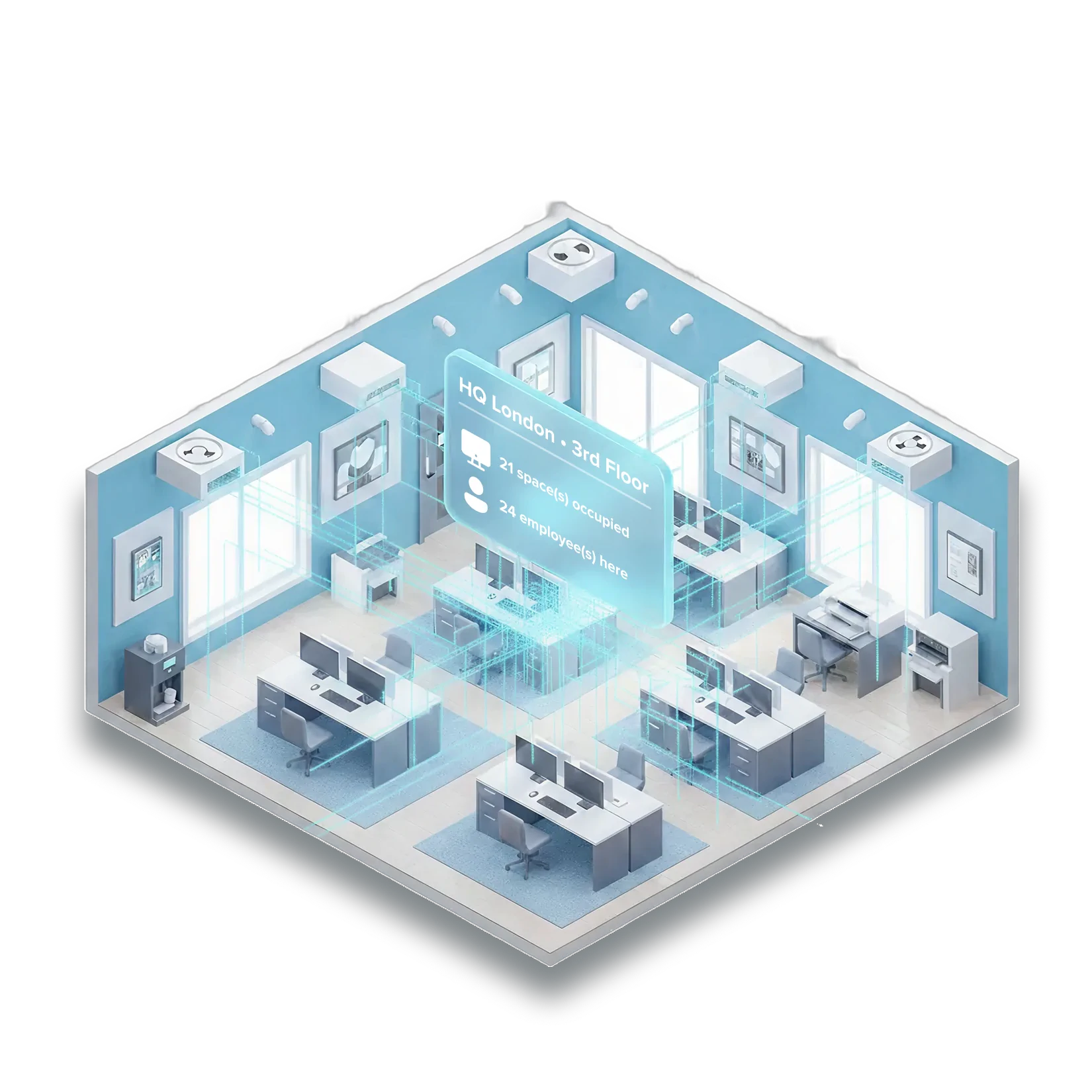
Kadence and deskbird are workplace management platforms serving different priorities.
Kadence started with team scheduling and WiFi-based automatic check-ins, then expanded fast: a conversational AI assistant (Kadence AI) built into Microsoft Teams and Slack, a rebuilt visitor management system, physical room displays, and, as of April 2026, SpaceOps for real estate scenario planning. deskbird was built as one connected system from day one: desk, room, and parking booking, visitor management, ticketing, and workplace analytics, in a single modular platform. Its own AI layer, Agentic Workplace, takes a different bet: instead of adding a chatbot to the booking screen, it automates the admin work behind the screen, onboarding, floor plan digitization, bulk changes, and the scenario analysis a CFO or real estate conversation actually needs.
Key differences are:
- AI approach: Kadence AI is a conversational layer for booking and coordination. deskbird's Agentic Workplace automates the admin work IT and facilities teams do by hand today, and connects to Microsoft Copilot, Claude, ChatGPT, and Gemini instead of locking you into one assistant.
- Check-in flexibility: deskbird supports QR codes, geofencing, user-triggered check-ins, and automatic sensor-free detection through deskbird Dock. Kadence's automatic check-in runs only through its desktop agent app, with no QR or manual option.
- Pricing transparency: deskbird publishes per-user pricing starting at €2.75/user/month, with monthly or annual billing and no lock-in required. Kadence does not publish pricing, requires annual billing with a 1-year minimum, and charges $250 per floor plan upload.
deskbird vs Kadence: an overview

Kadence
Detailed feature comparison
Features available
Why teams choose deskbird over Kadence

Workplace ticketing
Turn any issue into a resolved ticket. Employees scan a QR code, add a photo, and submit in seconds.

Enterprise-grade integrations
Integrates with HRIS, not just calendars. Auto-provisioning removes manual IT work at every onboarding and offboarding.

90%+ adoption rate
deskbird supports QR, geofence, user-triggered, and automatic sensor-free check-ins, so utilization data stays accurate regardless of how your team works.

Europe-first security
EU-hosted, GDPR-compliant, and SOC 2 Type II audited. No ambiguous data residency.
Both have great G2 ratings, but deskbird wins
Features available

Make office days worth the commute
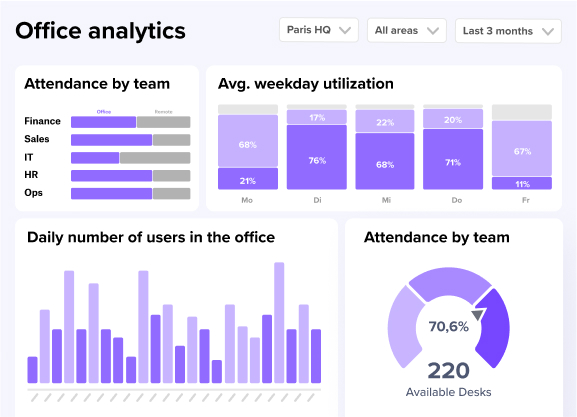
With deskbird, easily see who’s in the office, the rooms, parking spots and resources that have been booked, all while ensuring alignment with your hybrid work policy.

Strong, robust integrations
deskbird connects with Slack, Teams, Google Calendar, and Outlook, adding deep HRIS connections (eg. Personio, SAP) and an open API architecture.
Different approaches to workplace operations
Kadence's core strength is conversational coordination: ask Kadence AI to book a desk, invite a visitor, or check who's coming in, and it handles it inside Teams or Slack. With SpaceOps that extends into space scenario planning built on occupancy data the platform already collects.
deskbird takes a different view of where AI adds the most value. Booking a desk in deskbird already takes two taps, so a chatbot layer on top of that doesn't save much time. The bigger time cost sits in the admin work nobody automates: digitizing floor plans, onboarding a new office, running bulk changes across locations, building the utilization case for a real estate decision. That's where Agentic Workplace puts its effort, and it connects to whatever AI tools your company already runs, Microsoft Copilot, Claude, ChatGPT, or Gemini, instead of locking you into one assistant.
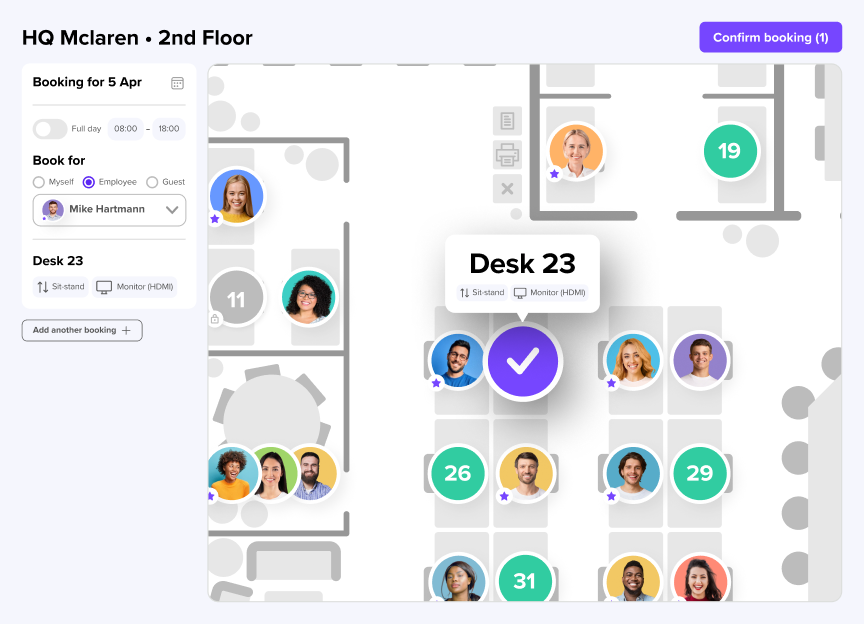
On the booking side itself, deskbird still gives employees fast, direct control: real-time availability on interactive floor maps, filtering by equipment, saved favorites, and recurring bookings in a few taps. For admins, deskbird supports hybrid work policies with attendance targets, custom approval workflows, and dashboards that show how office days are actually going across the organization.
deskbird leads in data regulation & security
Both platforms are SOC 2 Type II audited and ISO 27001 certified. deskbird goes further with Swiss headquarters and data hosted in Germany, with explicit GDPR compliance, making it the more straightforward choice for European organizations or any company handling sensitive employee data under strict regulatory frameworks. For teams running offices across both the US and Europe, deskbird's EU-hosted infrastructure meets data residency requirements without workarounds or extra legal review.
Kadence's US/UK-based infrastructure doesn't come with a clear EU data residency commitment. For European deployments, that can mean additional data processing agreements, more friction in vendor assessments, and questions from works councils.
deskbird has more transparent, scaleable pricing
Kadence's pricing isn't publicly listed. It requires annual billing with a 1-year minimum and charges $250 per floor plan upload, on top of any per-user cost, which makes total cost harder to predict as your office footprint grows.
deskbird features per-user pricing starting at €2.75/user/month (billed annually) or €3.50/month (billed monthly), with a free trial and no requirement to commit annually. Room, visitor, and advanced hybrid-work features are available on the Professional and Enterprise plans, so cost scales with what you actually need rather than every feature bundled in from day one.
When comparing total cost, factor in what's often overlooked:
- Adoption risk: a tool people don't use produces inaccurate data and wastes the investment
- Integration overhead: manual user management costs IT time at every onboarding and offboarding
- Reporting gaps: if analytics can't support real estate decisions, you're paying for a booking tool, not a workplace platform
deskbird is incredibly easy to use and quick to implement. The user interface is clean and intuitive, so our team had no trouble adapting to it. Booking desks, checking who’s in the office, and managing our hybrid schedules has become much more organized. The setup process was smooth, and the customer support team was responsive and helpful throughout.
deskbird or Kadence: which is the best workplace management system for your team?
If you're managing hybrid work across a mid-market or enterprise organization, the decision comes down to where you want AI to help. Kadence puts AI on the booking and coordination layer, and now on space scenario planning through SpaceOps. deskbird puts AI on the admin work behind the scenes and keeps booking fast and simple on its own, while still covering ticketing, EU-hosted compliance, HRIS integrations, and utilization analytics that hold up in a board-level real estate review. For teams that need accurate data, flexible check-in, and scalable operations across an AI stack they already use, deskbird is the stronger fit.
Disclaimer
Software listed in this article, and corresponding pricing and functionalities, are based on publicly available information as of July 2026 and are subject to change. Information provided without guarantee. If something is mapped out incorrectly, please contact us.
The workplace platform your team will actually use
deskbird combines effortless desk and room booking with real-time team coordination, space analytics, and hybrid policy enforcement.
Schedule your live demo
Book a demo with a workplace expert in your region, and we will show you how our intuitive workplace experience platform helps your teams collaborate and cut office space in half.
- Tailored to your organization, office & needs
- See our product in action
- You ask, we answer - all questions allowed
You already have an account
Please log in to your existing account.
Frequently asked questions
Additional questions on how deskbird and Kadence compare.
What's the main difference between deskbird and Kadence?
deskbird is a single connected platform for desk booking, room booking, visitor management, ticketing, and workplace analytics, built for European compliance and mid-market to enterprise hybrid teams. Kadence centers on a conversational AI assistant for booking and coordination, with newer additions in visitor management and space scenario planning through SpaceOps. If your priority is a fully connected platform with EU-hosted compliance and admin-side AI automation, deskbird is the stronger fit.
Is deskbird a good Kadence alternative for European companies?
Yes, and from a data hosting standpoint, it's the more straightforward default. deskbird is Swiss-headquartered, SOC 2 Type II audited and ISO 27001 certified, and EU-hosted, meaning your data stays in Europe. Kadence runs on US/UK infrastructure with no confirmed EU data residency commitment, which can add friction in GDPR-heavy environments and works council reviews.
How does deskbird’s pricing compare to Kadence?
Kadence doesn’t publish its pricing publicly, requires annual billing, and charges $250 per floor plan upload, making total cost harder to predict, especially as your office footprint grows. deskbird offers transparent per-user pricing starting at €2.50/user/month, with a free tier and no annual lock-in required.
How does deskbird's AI compare to Kadence AI?
Kadence AI is a conversational assistant for booking desks, rooms, and visitors inside Microsoft Teams and Slack. deskbird's Agentic Workplace instead automates the admin work behind the platform, onboarding, floor plan digitization, bulk changes, and strategic analytics, and connects to Microsoft Copilot, Claude, ChatGPT, and Gemini rather than one closed assistant. Both are legitimate approaches; the difference is where the AI effort goes.
Which is the most cost-effective solution for growing companies?
deskbird's published per-user pricing is easier to forecast and scales more predictably than Kadence's quote-only model, which adds a per-floor setup fee as your office footprint grows.
