Compare deskbird vs Robin
Compare features, pricing and use cases of these two workplace management platforms and see why more customers are switching to deskbird to manage their hybrid workplace.
Quick verdict
Robin is a capable workplace platform with strong room booking, a genuinely multi-part AI system (space suggestions, automatic desk booking, an AI analytics assistant, and an early-access scheduling agent), and employee experience features like built-in surveys. deskbird is built for teams that need the full hybrid workflow: desk and room booking, real-time attendance visibility, reliable utilization data, admin-side AI automation, and EU-hosted compliance in one platform.
The difference that matters most at scale: deskbird's adoption-first design produces data you can actually act on.
What's the difference between deskbird and Robin?
deskbird and Robin are both workplace management platforms targeting mid-market and enterprise hybrid teams. Robin started as a meeting room booking tool, expanded into desk booking, and has invested heavily in AI: automatic booking, an AI analytics assistant, and a scheduling agent that resolves conflicts on its own. deskbird was built from day one for the full hybrid workflow: desk booking, room booking, attendance coordination, analytics, and workplace operations in one connected system, with its own AI layer, Agentic Workplace, focused on the admin work behind the platform.
Robin invests heavily in occupancy intelligence, employee-facing AI, and employee experience signals. deskbird's focus is on making the daily experience so frictionless that employees actually use the product, which produces reliable data, and on automating the admin work that scales with a growing footprint.
Key differences:
- Hybrid attendance management: deskbird lets you set office-day targets, configure team-based schedules, and track attendance patterns. Robin's AI nudges and auto-books desks based on past behavior, but doesn't run structured attendance management workflows.
- AI approach: Robin's AI is employee-facing: space suggestions, automatic desk booking, an AI analytics assistant (built on Gemini), and a scheduling agent in early access. deskbird's Agentic Workplace is admin-facing: onboarding, floor plan digitization, and bulk changes, and connects to Microsoft Copilot, Claude, ChatGPT, and Gemini rather than one closed system.
- Workplace operations: deskbird includes Workplace Ticketing for facility issue tracking and resolution. Robin does not have an equivalent module.
- EU compliance: deskbird is ISO 27001 certified, SOC 2 Type II audited, and hosted in Germany with full GDPR compliance. Robin is U.S.-based with no clear EU data residency commitment, which creates friction in works council reviews and European procurement.
- Pricing transparency: deskbird publishes per-user pricing from €2.75/user/month with no annual lock-in required. Robin requires a custom quote and annual billing.
deskbird vs Robin: an overview

Robin
Detailed feature comparison
Features available
Why teams choose deskbird over Robin

Hybrid attendance management
deskbird lets teams set office-day targets, configure schedules by team or location, and track attendance patterns automatically.

Advanced check-ins
deskbird supports QR, geofence, and automatic sensor-free check-in via deskbird Dock, with strong HRIS integrations.

Transparent pricing
deskbird uses per-user pricing and published rates for smooth budgeting, with no annual lock-in required.

Europe-first data residency
deskbird's data is hosted in Germany for full GDPR transparency and no transfer gaps between US and Europe.
Both have great G2 ratings, but deskbird wins
Features available

Make office days worth the commute
With deskbird, easily see who's in the office, the rooms, parking spots and resources that have been booked, all while staying aligned with your hybrid attendance targets.

Strong, robust integrations
deskbird connects with Slack, Teams, Google Calendar, and Outlook, adding deep HRIS connections (e.g. Personio, SAP) and an open API architecture.
Different approaches to workplace operations
deskbird supports all-rounded hybrid work management
Robin's AI is genuinely capable on the employee-facing side: it suggests rooms based on meeting size, auto-books desks from past behavior, and its analytics assistant answers natural-language questions about space usage. Where it leans less is on structured attendance workflows and the admin-side work behind the scenes.
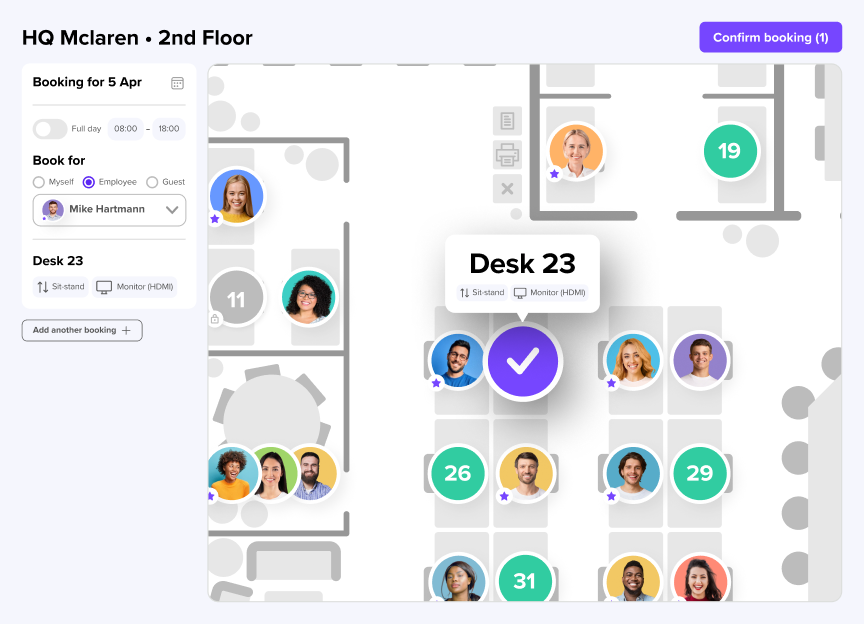
deskbird's approach to booking desks, rooms, and other resources is one of its core strengths: fast and frictionless, letting you know who's coming in on which days and seeing real-time availability on interactive floor maps. Filter by equipment, save favorites, and set up recurring bookings. Agentic Workplace then takes on the admin work behind that experience, onboarding, floor plan digitization, bulk changes, so IT and facilities teams aren't doing it by hand.
deskbird leads in data regulation & security
Both infrastructures are SOC 2 Type II audited and ISO 27001 certified. However, deskbird is Swiss-headquartered and fully EU-hosted in Germany, with explicit GDPR compliance, making it the default choice for organizations with European offices or any company handling sensitive employee data under strict regulatory frameworks. deskbird's EU-hosted infrastructure ensures data residency requirements are met without workarounds, legal grey areas, or last-minute procurement headaches.
Robin's US-based infrastructure can raise questions for European deployments. Without a clear commitment to EU data residency, companies could face additional data processing agreements, friction during vendor assessments, and potential blockers with works councils.
The importance of adoption
Most workplace analytics tools have a blind spot: the data is only as good as the adoption rate. A platform used by 50% of your team tells you about 50% of what's actually happening in the office. That's not enough to justify real estate decisions, right-size floors, or adjust cleaning and catering schedules with confidence.
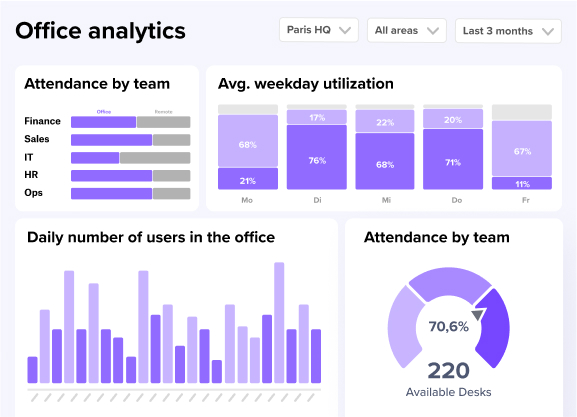
deskbird's 90%+ adoption rate means the data reflects how your office is actually being used, not just how part of it is. Workplace analytics show real peak days, real no-show patterns, and real zone utilization.
deskbird has more transparent, scalable pricing
Robin's pricing isn't publicly listed. Its quote-based model runs on annual sales cycles, which limits flexibility and makes total cost harder to predict.
On the other hand, deskbird offers transparent, per-user pricing starting at €2.75/user/month (annual) or €3.50/month (monthly). This model is more predictable and easier to budget against as teams grow.
Beyond upfront platform costs, keep in mind costs that are often overlooked:
- Admin overhead: How much time does user management and implementation take?
- Adoption risk: If the tool is hard to use, people won't use it
- Integration effort: Custom implementation work to connect with existing systems
- Reporting gaps: Additional manual work to extract the data you need
deskbird is incredibly easy to use and quick to implement. The user interface is clean and intuitive, so our team had no trouble adapting to it. Booking desks, checking who’s in the office, and managing our hybrid schedules has become much more organized. The setup process was smooth, and the customer support team was responsive and helpful throughout.
deskbird or Robin: which is the best workplace management system for you?
The right choice depends on the problems you're actually trying to solve. If your main challenge is hybrid coordination, helping employees find desks, book rooms, manage office attendance, and understand space utilization, deskbird was purpose-built for exactly that.
Despite Robin's strengths in AI-driven booking and employee experience features, many organizations find that deskbird covers those basics well enough, while delivering the compliance transparency, admin-side AI automation, and customizable analytics that justify real estate and workforce decisions at scale.
Disclaimer
Software listed in this article, and corresponding pricing and functionalities, are based on publicly available information as of August 2026 and are subject to change. Information provided without guarantee. If something is mapped out incorrectly, please contact us.
The workplace platform your team actually shows up for.
- 90%+ adoption. Your team will actually want to use it.
- Powerful integrations that include Microsoft Teams and Google
- ISO 27001 certified, SOC 2 Type II, GDPR compliant, EU-hosted in Germany
Schedule your live demo
Book a demo with a workplace expert in your region, and we will show you how our intuitive workplace experience platform helps your teams collaborate and cut office space in half.
- Tailored to your organization, office & needs
- See our product in action
- You ask, we answer - all questions allowed
You already have an account
Please log in to your existing account.
Frequently asked questions
Additional questions on deskbird, Robin and workplace management.
What's the main difference between deskbird and Robin?
deskbird focuses on hybrid workplace operations: desk booking, room booking, attendance coordination, and utilization analytics in a single, secure, EU-hosted platform, with AI applied to the admin work behind the scenes. Robin focuses on employee-facing AI, automatic booking, and occupancy intelligence. If your priority is a fully connected hybrid platform built for European compliance and structured attendance management, deskbird is the stronger fit.
Is deskbird a good Robin alternative for European companies?
Yes, and from a data security and hosting standpoint, arguably the better default choice. deskbird is Swiss-headquartered, ISO 27001 certified, SOC 2 Type II audited, and EU-hosted, meaning your data never leaves Europe. Robin is US-based and SOC 2 Type II certified with no clear commitment to EU data residency, which creates friction in GDPR-heavy environments, works council reviews, and enterprise procurement.
How does deskbird’s pricing compare to Robin?
deskbird offers transparent per-user pricing starting at €2.75/user/month (annual) or €3.50/month (monthly), with no annual lock-in required. Robin doesn't publish pricing publicly, requires quote-based sales cycles, and bundles features into higher enterprise tiers, making total cost harder to predict, especially as your office footprint grows.
How does adoption affect workplace analytics accuracy?
Workplace analytics are only reliable if most of your team uses the platform consistently. deskbird's employee-first UX drives a 90%+ adoption rate, which means its occupancy data reflects real usage patterns. Higher adoption leads to more complete data, which supports better space and real estate decisions.
Does deskbird also offer visitor management workflows?
Yes. While Robin has polished visitor workflows, deskbird also supports visitor booking, approvals, QR check-in, and time-based access rules, and continues to expand kiosk functionality.
Which is the most cost-effective solution for growing companies?
deskbird's per-user model is easier to forecast and scales more predictably than Robin's quote-based, annual-only pricing.
