Compare deskbird vs Skedda
Compare features, pricing and use cases of these two workplace management platforms and see why hybrid teams are switching to deskbird.

Quick verdict
While Skedda's strength lies in resource scheduling for multi-space facilities, it's built primarily as a booking engine. deskbird goes beyond that, covering the full hybrid workplace stack: desk and room booking, attendance coordination, and utilization analytics, all in a single EU-hosted platform. If your priority goes beyond scheduling into actually managing how, when, and where your team works, deskbird is the stronger fit.
Key differences between deskbird and Skedda
deskbird and Skedda both cover desk and room booking, but they are built around fundamentally different scopes.
Skedda is a capable scheduling platform, strong on booking rules and space configuration across varied resource types. It handles the "can I book this space" question well. deskbird is a full workplace management platform. It covers booking, attendance coordination, utilization analytics, and issue resolution, all in one place. And because it's built for daily employee use, not just admin configuration, the data it generates is consistent and reliable.
Key differences:
- Scope: Skedda focuses on scheduling and space configuration. deskbird manages the full workplace: who's coming in, when, where they sit, how space is being used, and what needs fixing.
- Focus on adoption. Utilization analytics are only useful if employees are actually booking. Higher adoption, like deskbird's 90%+ rate, means more complete data. More complete data means space decisions based on what's actually happening, not estimates.
- Integrations: deskbird is built into Microsoft Teams and Outlook natively, so employees book without changing apps. That's what drives adoption at scale. Skedda offers calendar sync but doesn't embed as directly into the Microsoft ecosystem.
- Pricing: Skedda prices per space, starting at $99/month (billed annually). deskbird prices per user, starting at €2.75/user/month, scaling with headcount rather than floor plan size.
deskbird vs Skedda: an overview

Skedda
Why teams choose deskbird over Skedda

Analytics that close the loop
More employees booking means more accurate data. Better data means smarter space decisions.

Deep integrations
Integrates with your tech stack and daily workflows, including Microsoft Teams, Outlook, Google, HRIS, Slack, and SSO tools.

Hybrid workforce management
deskbird supports hybrid policies and approval workflows, not just basic booking rules.

AI capabilities
Agentic Workplace handles onboarding, floor plan digitization, and bulk admin changes automatically, so facilities and IT stop doing it by hand.
Detailed feature comparison
Features available

Run your hybrid office on autopilot
deskbird lets you set capacity limits by floor or zone, restrict booking to certain groups, and assign hybrid work schedules that balance flexibility with predictability.

Superior integrations with your stack
deskbird connects with Slack, Teams, Google Calendar, and Outlook, adding deep HRIS connections (eg. Personio, SAP) and an open API architecture.
deskbird vs Skedda: key differences
deskbird is built for managing hybrid organizations
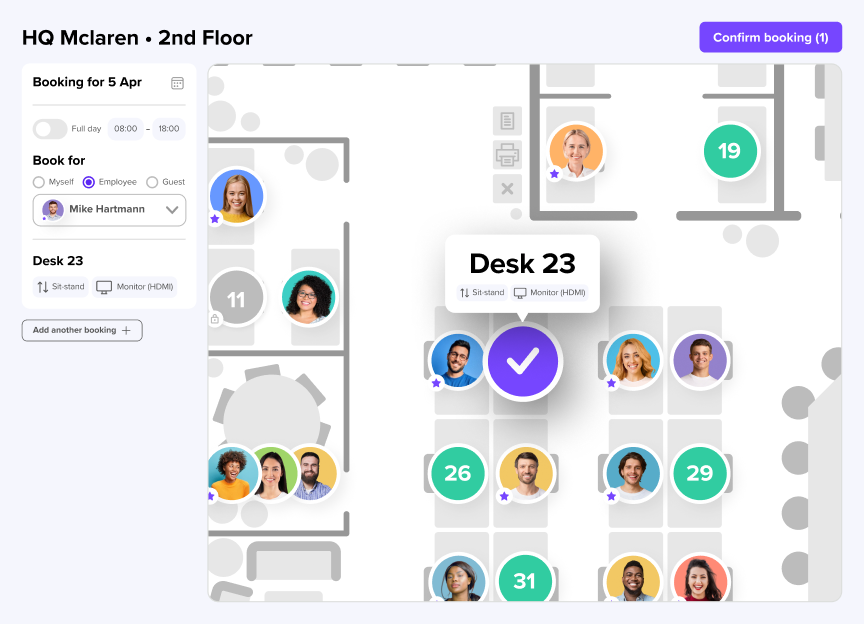
deskbird shows who plans to come in on which days, lets employees follow colleagues, and displays availability on interactive floor plans. Beyond both intuitive and advanced desk booking options, you can book parking spots, catering and equipment, and manage office issues with smart ticketing.
As for meeting rooms, deskbird syncs directly with Outlook and Google Calendar, so employees book rooms without switching apps. Automatic check-in releases unused rooms, and kiosk displays show real-time availability at the door.
If your team lives in the Microsoft 365 ecossystem, the native Teams and Outlook integration in deskbird tends to drive higher daily usage. A few other things worth checking when you evaluate desk booking tools:
- Teammate visibility: Can employees see where colleagues are sitting?
- No-show prevention: Does the system use check-ins to release unused bookings?
- Zone rules: Can you set capacity limits or restrictions for specific areas?
deskbird has more robust integrations
Skedda offers calendar sync but doesn't embed as deeply, with more of a focus on Slack. For hybrid teams that live in Outlook, Teams, or Google Workspace, deskbird integrates tightly with all three, so employees book desks and rooms without leaving the apps they already use.
Enterprise IT teams care about identity management. SSO (single sign-on) lets employees log in with their existing company credentials, and SCIM (System for Cross-domain Identity Management) automates user provisioning, so when someone joins or leaves, their access updates automatically.
deskbird supports SAML/OIDC single sign-on and SCIM, while the open API architecture means it connects nicely with your entire tech stack, whether they are HR, IT, calendars, or work collaboration tools without creating integration silos.
deskbird brings AI to the table
Booking a desk in deskbird already takes two taps, so a chatbot on top of that wouldn't save much time. The real time cost sits in the admin work nobody automates: digitizing floor plans, onboarding a new office, running bulk changes across locations, building the utilization case for a real estate decision. That's where Agentic Workplace puts its effort, and it connects to whatever AI tools your company already uses, Microsoft Copilot, Claude, ChatGPT, or Gemini, instead of locking you into a single assistant.
Skedda has no AI assistant, automation layer, or agent capability as of mid-2026. For IT and facilities teams evaluating both platforms, that's a meaningful gap if reducing manual admin work is part of the business case.
deskbird leads in data regulation & security
Skedda publishes SOC 2 Type 2 certification and GDPR compliance via Data Processing Agreements directly on its own site, so it's not lacking on the certification front. Where it does fall short for European buyers is data hosting: Skedda doesn't commit to EU-based infrastructure, which can be a friction point during assessments in regulated industries or companies with strict data residency mandates.
deskbird is built and hosted in Germany with explicit GDPR compliance, making it the default choice for European organizations or those handling sensitive employee data under strict regulatory frameworks. If you're operating across multiple geographies (for example, offices in both the United States and Europe), deskbird's transparent security posture and German infrastructure eliminate compliance uncertainty around data transfer and privacy, without workarounds.
deskbird has a more scaleable pricing scheme
Per-space pricing used by Skedda starts at $99/month, billed annually, for 15 spaces. deskbird's per-user pricing model offers transparent pricing so teams only pay for the features needed at their stage of growth. Plans start at €2.75/user/month (annual) or €3.50/month (monthly), and include room bookings, visitor management, and hybrid working features.
For companies moving from tools like Skedda, deskbird delivers stronger long-term ROI by improving in-office presence and reducing operational complexity.
When comparing total cost, factor in what's often overlooked:
- Adoption risk: A tool people don't use produces inaccurate data and wastes the investment
- Integration overhead: Manual user management costs IT time at every onboarding and offboarding
- Reporting gaps: If analytics can't support real estate decisions, you're paying for a booking tool, not a workplace platform
deskbird is incredibly easy to use and quick to implement. The user interface is clean and intuitive, so our team had no trouble adapting to it. Booking desks, checking who’s in the office, and managing our hybrid schedules has become much more organized. The setup process was smooth, and the customer support team was responsive and helpful throughout.
deskbird or Skedda: which is the best workplace management platform for your team?
While both deskbird and Skedda streamline space reservations through interactive floor plans and intuitive booking interfaces, they serve fundamentally different workplace needs.
Skedda handles scheduling well. If that's the primary need, it's a solid tool. However, if your goal is to understand how your office is actually being used, manage hybrid attendance, and make real estate decisions backed by reliable data, you need more than a booking engine. You need a platform people use consistently, because the data is only as good as the adoption behind it.
For enterprises managing hybrid work at scale, deskbird delivers ROI by reducing wasted office space, improving attendance accuracy, and enabling data-driven workplace strategies.
Disclaimer
Software listed in this article, and corresponding pricing and functionalities, are based on publicly available information as of July 2026 and are subject to change. Information provided without guarantee. If something is mapped out incorrectly, please contact us.
One platform. Your entire workplace ecosystem.
deskbird combines effortless desk and room booking with real-time team coordination, analytics, and hybrid policy enforcement.
Schedule your live demo
Book a demo with a workplace expert in your region, and we will show you how our intuitive workplace experience platform helps your teams collaborate and cut office space in half.
- Tailored to your organization, office & needs
- See our product in action
- You ask, we answer - all questions allowed
You already have an account
Please log in to your existing account.
Frequently Asked Questions
Additional questions on deskbird and Skedda comparison.
Can deskbird and Skedda integrate with Microsoft Teams and Outlook?
Both platforms offer calendar integrations. deskbird provides a native Teams app and deep Outlook integration, so employees book without leaving their usual tools in just two clicks. Skedda syncs with calendars but doesn't embed as directly into the Microsoft ecosystem.
Does deskbird or Skedda offer AI features?
deskbird does, through Agentic Workplace. It automates admin-heavy tasks like onboarding, floor plan digitization, and bulk changes, and works alongside Microsoft Copilot, Claude, ChatGPT, and Gemini rather than replacing them. Skedda has no AI assistant or automation layer in its product as of mid-2026.
Which platform is easier to roll out to employees?
Both can be set up fairly quickly. The difference for some teams comes down to UX and daily adoption. deskbird's user-friendly interface, along with employee-oriented features like seeing who's coming in or following teammates, tends to drive higher engagement in hybrid teams.
Does deskbird offer visitor management?
Yes. deskbird includes built-in visitor management with pre-registration, automated invitations, self-check-in via tablet or kiosk, and host notifications through Teams. If managing external guests is part of your workflow, this difference matters.
Do deskbird and Skedda have workplace ticketing functionalities?
Only deskbird does. Skedda does not offer a native ticketing module. deskbird includes Workplace Ticketing, which lets employees report issues directly from the app they already use to book their desk. Facilities teams receive structured, trackable requests instead of scattered emails or chat messages, included in the platform, with no separate tool or integration required.
Which platform provides better analytics for office utilization?
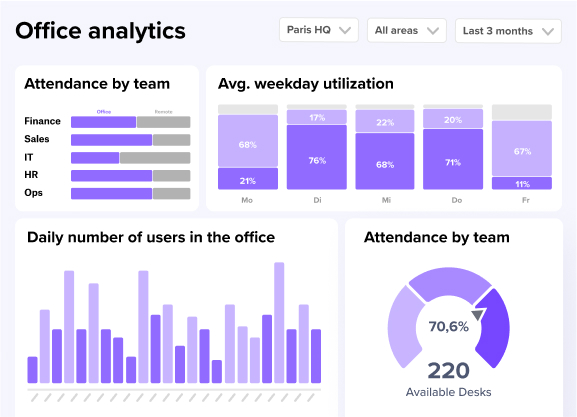
Skedda provides reporting on bookings but less depth for strategic space planning. deskbird offers detailed workplace analytics, including utilization by location and zone, attendance patterns, peak-day tracking, and no-show rates. With adoption rates above 90%, this reliable data helps justify real estate decisions and measure the impact of hybrid policies.
Which is the most cost-effective solution for growing companies?
deskbird's per-user model scales more predictably as your organization grows, without the per-space add-on fees or annual billing requirement that come with Skedda.
