

How to right-size your office space with real data
Most CFOs approve office leases based on headcount projections, but hybrid work has broken that model. Right-sizing office space now requires matching your real estate footprint to actual attendance patterns, not the number of employees on payroll, and that shift demands reliable utilization data, a cost model that accounts for shadow vacancy and operating expenses, and a phased execution plan that protects both capital efficiency and employee experience.
TL;DR
Right-sizing office space means matching your real estate footprint to actual employee attendance, not headcount on paper. For CFOs, this requires reliable utilization data, a clear cost model that includes hidden expenses like shadow vacancy, and a phased execution plan that avoids disruption.
- Attendance patterns, not employee count, determine how much space you actually need
- Shadow vacancy and operating costs often exceed base rent in total impact
- A 90-day phased approach reduces execution risk and builds stakeholder confidence
What does right-sizing an office mean?
Right-sizing adjusts your office footprint to match how many people actually show up each day. Real attendance data matters here, not the number of employees on your payroll. In hybrid environments, the gap between seats leased and seats used represents a significant financial drain.
For you as a CFO, this is a capital efficiency decision. You want to stop paying for empty space while ensuring employees still have what they need to work effectively. The goal is a defensible number you can present to the board. Rough estimates from facilities won't cut it.
Inputs determining the right office footprint
Before approving any footprint decision, you need specific inputs. Headcount alone misleads because employees rarely come to the office all at once. Actual behavior reveals true space demand.
Peak day patterns show which days see the highest attendance. Tuesday through Thursday are typically the busiest, with Tuesday at 58.6% occupancy according to Workplace Insight. Your growth forecast matters too: you need to account for planned hiring or reductions over the lease term. Your hybrid work policy directly affects space demand as well. A 3-day in-office requirement needs more capacity than a 2-day policy.
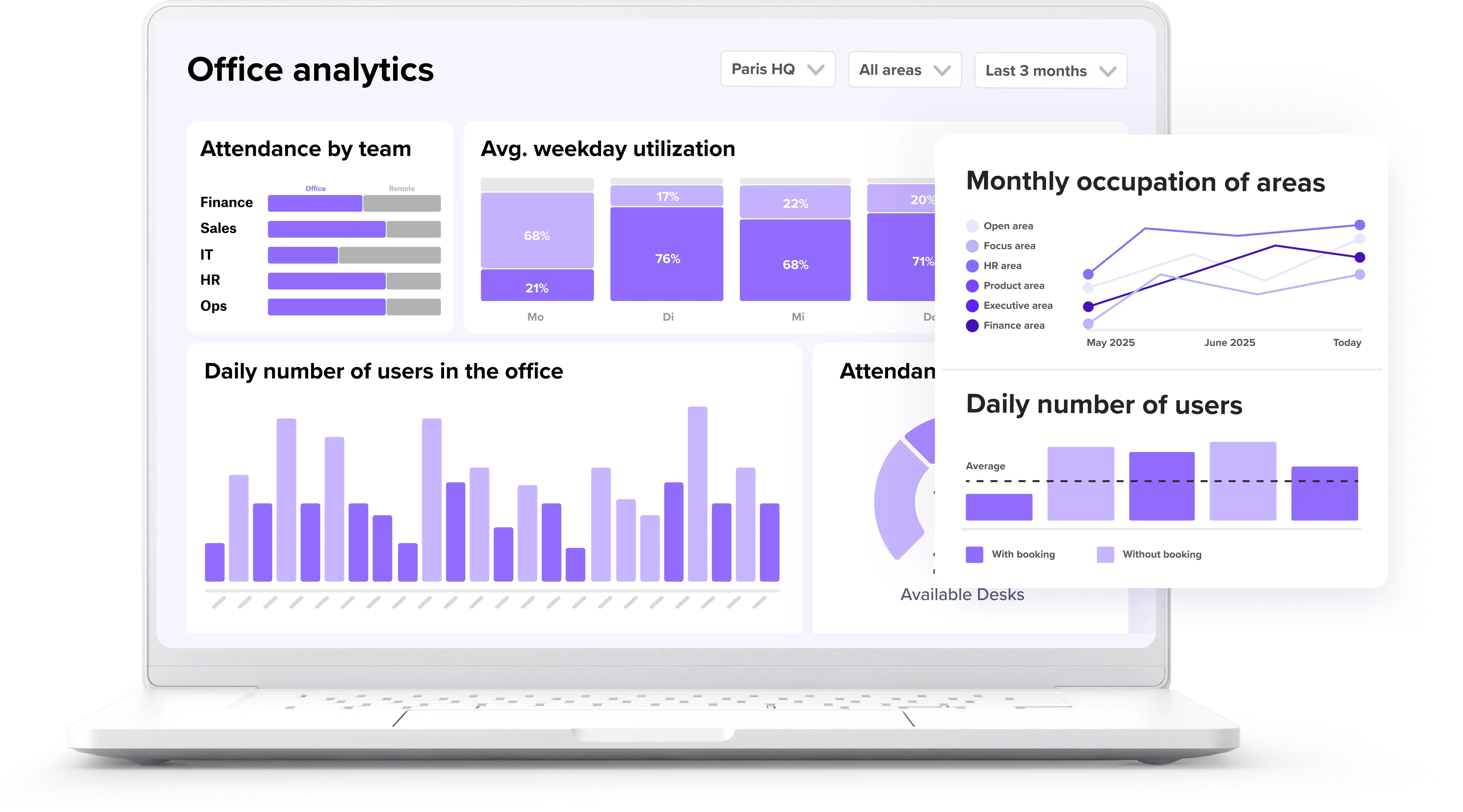
Utilization metrics that matter for right-sizing
Request specific metrics from your workplace or facilities teams. Data quality matters because ghost bookings and no-shows distort the picture. Gable research shows only 7% rate their data capabilities as excellent. Reliable data requires a system employees actually use daily.
[Table1]
Occupancy rate and peak days
Occupancy data shows how full your office gets on specific days. Averages hide peaks, and that creates risk. Sizing for the average leaves you short on busy days. Sizing for the peak wastes money on quiet days. You need both numbers before making a decision.
Desk utilization and sharing ratios
Desk utilization compares how many desks are booked against how many are actually occupied. A desk sharing ratio defines how many employees share a single desk, such as 1.5 employees per desk. Check-in data from your workplace management platform validates these ratios.
Meeting room utilization
Meeting rooms are often the actual bottleneck, not individual desks. Look at the room size mix. Small huddle rooms for 2 to 4 people are typically overbooked while large boardrooms sit empty. This data helps you reconfigure existing space before acquiring more real estate. A useful benchmark: meeting rooms should account for 15 to 20% of your total office footprint, with a mix of small huddle rooms and larger rooms to match actual demand.
Dead zones and wasted space
Dead zones are areas of the office that remain consistently underused. Identifying these zones helps you decide whether to repurpose the space, close it off to save energy, or sublease it. Every square foot should serve a clear purpose.
How to translate occupancy data into target square footage
Translating attendance data into a target size requires a structured approach. Start by identifying your peak attendance day and your average daily attendance. The difference between these two numbers tells you how much buffer you need.
Apply a buffer of 10 to 20% to account for unexpected growth and daily variability. Multiply this adjusted headcount by your target square feet per person. Industry standards range from 125 to 250 square feet per person depending on work style and collaboration needs. If you want to run the numbers for your own office, deskbird's office space calculator lets you apply these benchmarks to your actual attendance data.
Add dedicated square footage for meeting rooms, collaboration zones, and amenities. Comparing this number against your current footprint reveals exactly how much excess capacity you carry.
How many desks and meeting rooms does a hybrid office need
Employees often complain they cannot find a desk or a room. This perceived scarcity is usually a booking behavior problem, not a true space shortage. Booking data often reveals a massive gap between actual demand and resource hoarding.
In a hybrid model, you rarely need 1 desk per employee. The exact ratio depends on your policy and historical attendance patterns. Most hybrid offices operate effectively with ratios between 1.2 and 1.8 employees per desk.
What about the common objection that you'll run out of space? Ghost bookings frequently cause this concern ie. employees book spaces just in case and fail to show up. Implementing check-in enforcement fixes this issue and frees up inventory automatically.
Which costs belong in the business case beyond rent
A complete business case must include several cost categories beyond the monthly lease payment. Base rent is the obvious line item, but it rarely tells the whole story.
[Table2]
Shadow vacancy is a hidden cost: you pay for space that sits empty on quiet days. Operating expenses like utilities and cleaning scale directly with your physical footprint. Larger footprints also mean higher energy bills, so reducing space directly lowers your carbon impact.
Which right-sizing option fits your portfolio
You have several paths to right-size your real estate portfolio. Each option carries specific tradeoffs that impact your financial model and timeline.
Consolidating floors or buildings works best when you have significant overcapacity and a long lease runway. The tradeoff is disruption and potential employee pushback. If consolidation means a full relocation, a structured office move management plan is what keeps booking data and floor plans accurate through the transition. Redesigning your layout suits moderate overcapacity when you have lease flexibility, though it requires CapEx and change management effort.
Adopting flex or coworking space works for uncertain demand and short-term needs. You trade control for flexibility. Subleasing unused space works when you have excess capacity and a strong sublet market. You take on tenant risk and administrative burden in return.
What risks can derail right-sizing after approval
Execution risk matters just as much as the initial business case. Several common failure points can derail your project after you sign off on the budget.
Unreliable utilization data means your target footprint is essentially a guess. Lease clauses like break options, notice periods, and sublease restrictions can severely limit your flexibility. Change management hurdles arise when employees resist modifications to their daily routines.
Tool adoption is the hidden risk. If employees avoid using the booking system, your data stays unreliable and your space planning suffers. Adoption rates matter as much as feature lists when evaluating workplace management platforms.
How to calculate ROI for right-sizing
A simple ROI framework helps you validate the financial impact of your real estate decisions. Start by calculating your baseline total cost of occupancy, including rent, operating expenses, and energy.
Project your target state costs after right-sizing to a smaller footprint or flexible mix. Subtract one-time costs like fit-outs, moving expenses, and new technology from your projected savings. This gives you your payback period.
Run sensitivity analyses against different attendance scenarios: what happens if attendance increases by 20%? What if the sublease market weakens? Your model should be transparent and easy to update as assumptions change.
A 90-day plan to right-size without disruption
A phased timeline with clear milestones helps you execute smoothly. Speed matters for cost savings, but stakeholder buy-in is essential for long-term success.
1. Validate utilization data
During the first 4 weeks, audit your current data quality and implement check-in enforcement and auto-release rules for no-shows. This step ensures your baseline numbers reflect reality rather than booking intentions.
2. Build scenarios and select a target
During weeks 5 through 8, model conservative, moderate, and aggressive space scenarios. Involve your facilities, HR, and finance teams to review the options. Select a target footprint that balances cost savings with employee experience.
3. Implement booking rules and track outcomes
Roll out new booking policies during weeks 9 through 12. Set a regular measurement cadence to monitor how the new rules impact space usage. Adjust your strategy based on continuous feedback and data.
Make right-sizing decisions with data you can trust
The hardest part of right-sizing is getting reliable data that reflects actual office usage. Accurate utilization data is only possible if employees actually use your workplace tools. Adoption rates matter as much as analytics capabilities.
deskbird combines enterprise-grade workplace analytics with a user experience that drives adoption without training. The platform integrates directly with MS Teams, Slack, Outlook, and major HRIS systems through SCIM auto-provisioning and SSO. Built and hosted in Europe with ISO 27001, SOC 2 Type II, and GDPR compliance, deskbird gives you the data foundation for defensible real estate decisions, see your right-size scenario in a demo.

Frequently Asked Questions
What is the difference between occupancy rate and desk utilization?
How do you determine the right desk sharing ratio for a hybrid office?
What is shadow vacancy in office real estate?
How often should a CFO review office utilization data?
Can you right-size office space without disrupting employees?
What tools out there can help size and plan my workspace?
Tools like deskbird's office space calculator allow you toestimate the right amount of desks and office space for your team to optimize costs.
Right-size your office with the right data
- See how your attendance data translates into a target footprint
- Get a clear cost model that includes shadow vacancy and operating expenses
