How to measure hybrid work success: metrics, KPIs, and more
How to measure hybrid work engagement and productivity using outcome-based KPIs.

When measuring hybrid work success, you need to focus on outcomes and metrics that matter, such as productivity, engagement, collaboration, space utilization, and employee retention. Meaningful metrics let you move past pure presence tracking and performance “paranoia” to focus on what drives real impact. Tracking the right metrics and KPIs helps you understand whether your hybrid model is delivering value or needs adjusting.
Key takeaways:
- Outcomes over activity: Focus on results like quality outputs, engagement, and retention, not superficial presence metrics.
- Balance business and people: Track both organizational metrics (cost, ROI, space use) and human metrics (engagement, well-being, intent to stay).
- Keep evolving: Review your metrics regularly to make sure they stay relevant as work patterns and employee needs change.
Why hybrid work success metrics matter
Tracking hybrid work metrics helps organizations better understand the success of their hybrid work model (or lack thereof) and make the necessary adjustments. They turn the vague concept of hybrid work success into a tangible, measurable outcome and show if hybrid work has the expected positive impact on your organization. To assess this, you need to look at several different aspects, including:
- Business outcomes (ROI): Hybrid work can help businesses save money through reduced office costs, improved space utilization, and better employee retention.
- Employee engagement: When done right, hybrid work can boost employee engagement, satisfaction, motivation, and well-being.
- Collaboration and performance: Coordinated hybrid work helps teams collaborate more effectively. Tracking collaboration quality can show whether hybrid work enables effective teamwork or creates silos.
- Equity and inclusion: Establishing clear metrics helps ensure that both remote and in-office employees have equal access to information, career opportunities, recognition, and training.
- Continuous improvement: Monitoring the right KPIs delivers the insights needed for refining your hybrid work policies, schedules, resources, and more.
- Strategic alignment: Defining and monitoring hybrid work KPIs ensures that your hybrid work goals are tied directly to your organizational objectives and supports data-driven decision-making.
My view is that when done right, hybrid enables productivity to flourish. I’m looking forward to organizations measuring tactical and short-term metrics and increasingly more sustainable long-term human metrics. This will create a rich data picture of how productivity shows up in their organization and is supported by hybrid.
—Harriet Molyneaux, Advisor and Non-Executive Director at HSM
How to pick the right hybrid work success metrics
When deciding which metrics to track, focus on outcomes over activity and go for a mix of quantitative and qualitative data. Pick metrics that not only track short-term efficiency but also reflect culture, retention, and overall employee experience. The key to measuring hybrid work success is choosing metrics that are meaningful, easily measurable, and actionable.
The most important Do’s
- Start with purpose: Define what hybrid work success means for your organization (e.g., more productivity, engagement, collaboration, well-being) and align your metrics with business goals and employee experience.
- Involve leadership and key stakeholders: Picking hybrid work metrics requires C-Suite involvement to ensure organizational and strategic alignment and weigh the importance of each metric.
- Measure outcomes, not activity: Focus on deliverables, quality of work, and progress toward goals. Real impact comes from results, not from presence.
- Balance organizational and employee metrics: Track both business outcomes (e.g., ROI and space utilization) and outcomes on the employee side (e.g., engagement or well-being) to ensure hybrid work stays sustainable for both the company and its people.
- Keep it simple: Keep the number of tracked metrics manageable and focus on a set number of core KPIs.
- Mix quantitative and qualitative measurements: Combine quantitative data from surveys with qualitative input from focus groups and other feedback channels.
- Review regularly: Reassess and adjust metrics regularly as your hybrid practices evolve.
- Adopt proven frameworks: Use outcome-based hybrid leadership models like ROWE (Results-Only Work Environment) as guidance and encourage autonomy while holding teams accountable.
The most important Don’ts
- Avoid productivity paranoia: Don’t measure keystrokes, clicks, or webcam presence. These metrics erode trust and encourage performative behavior rather than real productivity.
- Don’t focus on presence tracking: Hours logged online, badge swipes, or days-in-office metrics don’t reflect impact. Hybrid success is about outcomes and collaboration, not physical or digital presence.
- Avoid pure performative tracking: Vanity metrics (e.g., number of meetings attended or messages sent) give a false sense of productivity. Instead, prioritize metrics that demonstrate value, such as project completion, innovation, and customer impact.
In their quest for productivity, many organizations are piling on the pressure to increase the number of calls per hour for contact center colleagues and scaling back their hybrid working flexibility. And I get it – when you take a traditional, short term and commercial view of productivity, these all feel like good decisions. So why aren’t these tactics working? Well, I think the metrics organizations look at aren’t always the full picture of productivity.
— Harriet Molyneaux, Advisor and Non-Executive Director at HSM
How to track hybrid work success
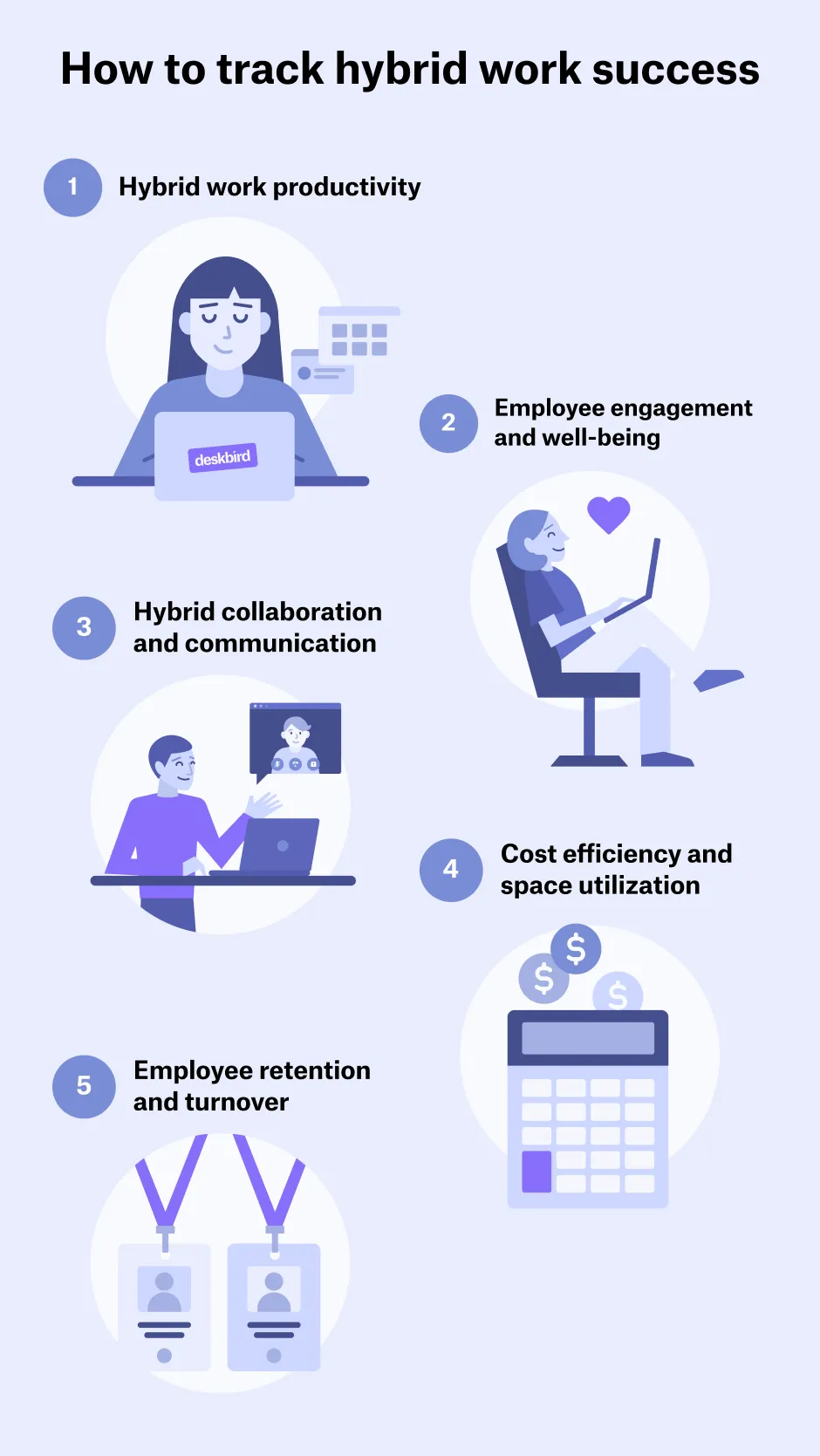
Hybrid work metrics for the workplace should combine both organizational and employee-related indicators. The five essentials are productivity, engagement, collaboration, cost efficiency, and retention. Together, these metrics give you a holistic view of whether your hybrid work policies are driving performance, supporting employees, and delivering actual value for your business.
1. Hybrid work productivity metrics
Productivity is one of the clearest ways to see if your hybrid setup is working. It shows whether outputs are improving compared to traditional office-based work arrangements and if your hybrid model is sustainable.
- Quantity and quality of outputs: Track volume delivered via project tools and check quality of work through feedback, reviews, or error rates.
- Goals achieved: Measure progress against SMART goals (specific, measurable, achievable, relevant, time-bound) for fair comparisons across hybrid setups.
- Project completion rate: Compare planned vs. delivered projects to spot delays or blockers.
- Revenue or value per employee: Divide revenue (or another chosen value metric) by headcount to see how efficiently your workforce is turning effort into outcomes and profits.
- Task turnaround time: Look at how quickly tasks are completed from start to finish, and how effectively employees prioritize and plan their time to see if deadlines are being met without burning people out.
I would define productivity as multi-faceted. It includes the tactical components we currently measure, but we also need to account for sustainable productivity more consistently, which is dynamic and influenced by how people work and feel.
—Harriet Molyneaux, Advisor and Non-Executive Director at HSM
2. Employee engagement and well‑being metrics in hybrid work
Employee engagement and well-being tell you whether your hybrid policies are motivating people—or leaving them feeling disconnected. They also directly affect productivity, retention, and morale, and since burnout is harder to spot remotely, you need clear signals to track it.
- Employee Net Promoter Score (eNPS): Ask how likely employees are to recommend your company. Rising scores mean alignment, falling ones flag issues.
- Participation in initiatives: Track involvement in training, surveys, or events. Steady engagement shows connection, drops are a sign of disengagement.
- Energy and stress indicators: Survey motivation, stress, and digital overload and use these results to prevent burnout with wellness tools.
- Absenteeism and work-life balance: Monitor sick leave, vacation time, and overtime trends. If people aren’t taking time off or are working long hours, it’s a warning sign.
3. Hybrid collaboration and communication metrics
Collaboration and communication can make or break hybrid work success, so track whether teams are truly connecting, sharing knowledge, and using tools effectively. The right metrics show if meetings, tools, and workflows drive outcomes or if they just create additional friction and take up valuable time in employee calendars.
- Meeting quality and engagement: Don’t just look at mere attendance. Ask whether employees are contributing, decisions are being made, and meetings lead to action.
- Collaboration tool adoption and usage: Check how consistently your teams use hybrid work tools. Usage patterns tell you if tools are enabling seamless collaboration.
- Cross-team collaboration: Measure joint projects, shared files, and task ownership to spot silos or collaboration wins.
- Manager-employee connections: Track how often managers hold one-on-one check-ins to keep alignment, support, and engagement strong across locations.
- Knowledge sharing: Review contributions to shared knowledge platforms or forums. Active sharing shows that information flows freely.
4. Cost efficiency and space utilization metrics
Hybrid work is your chance to cut costs and optimize office space. By tracking how much space you’re using, how it’s being used, and what it costs, you can align your footprint with real demand and unlock savings with better real estate decisions.
- Space per employee: Divide the total office square footage by the number of employees to determine how much space is taken up by each person.
- In-office attendance distribution: Track how many days employees spend in the office versus working remotely.
- Occupancy and utilization rates: Compare office capacity to actual occupancy levels to see how effectively space is being used, including daily occupancy rates and average peak utilization.
- Workspace popularity: See which desks, rooms, or areas get used most to guide changes in your office layout.
- Real estate cost per employee: Calculate total real estate costs (leases, utilities, maintenance) divided by the number of employees to understand the cost of providing physical space on a per-person basis.
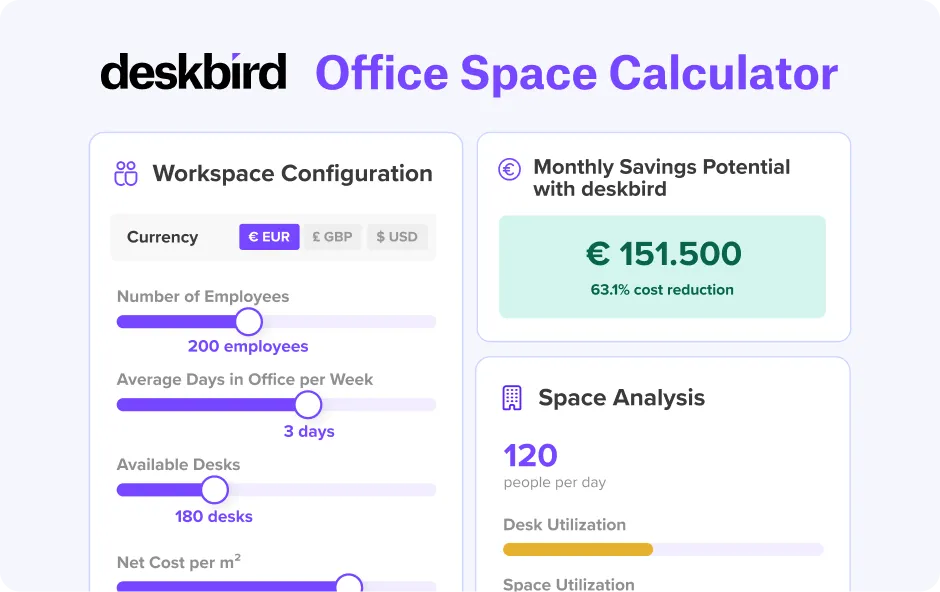
- Overall cost savings: Measure cost savings from downsizing, consolidation, or flexible working strategies. According to CBRE, space optimization opportunities linked to hybrid work can lead to savings between 10% and 50%. Try our office space calculator to configure your workspace and determine how much you could save every month using deskbird.
5. Employee retention and turnover metrics
Retention and turnover show you whether your hybrid model is keeping people engaged or pushes them away. Together, they show if your policies foster stability, meet employee needs, and support long-term growth. Comparing trends before and after hybrid work implementation gives you a clear understanding on whether or not hybrid work is working for your teams.
- Voluntary turnover: The percentage of employees who resign within a given timeframe. Rising resignations signal dissatisfaction, while stable or falling rates show employees are happy with the setup.
- High-performer retention: Track if top talent stays. High attrition among high performers can be more damaging than general turnover.
- Average employee tenure: Shorter tenures may be a sign of disengagement, poor cultural alignment, or hybrid work challenges.
- New hire one-year retention: One-year rates show how well onboarding and integration work in hybrid setups.
- Employee intent to stay: Survey your employee’s likelihood to remain. Early warnings help prevent turnover spikes.
Hybrid work ROI: Real-life examples and benchmarks
The ROI of hybrid work is best measured through clear KPIs that show how flexibility impacts business performance and employee experience. Organizations that track hybrid success commonly report revenue growth, cost savings, productivity gains, higher well-being, and stronger retention. By benchmarking against these real-life examples, you can set realistic goals, measure progress, and prove the value of your own hybrid model.
- Companies with teams spread across different locations (e.g., home, office, client sites) are more likely to grow faster. 35% of hybrid organizations saw over 10% revenue growth, compared to just 28% of non-hybrid ones.
- In a 2025 CEO survey, 79% of leaders said hybrid work reduced costs, 72% reported better productivity, and 71% said it helped them attract and retain top talent.
- 85% of hybrid employees say this setup enhances their well-being—something that’s closely linked to motivation and long-term performance.
- Hybrid setups help teams stay intact and connected. 69% of employers say retention improved after rolling out hybrid work, especially those offering just one in-office day a week, who saw a boost of up to 41% in retention.
The role of digital tools in tracking hybrid work success
Digital tools turn hybrid work from guesswork into strategy. They give you the data and insights you need to understand if your setup is working, where adjustments are needed, and how to make smarter decisions about office space, schedules, and policies. Platforms like deskbird make insights actionable through analytics and seamless integrations.
- Hybrid office analytics: With deskbird’s analytics features, you can track daily office use, see which desks or rooms are most/least used, and match real estate to actual demand.
- Hybrid scheduling analytics: Monitor attendance patterns, balance office demand across the week, and check policy compliance.
- HRIS & sensor integration: deskbird integrates seamlessly with the tools you’re already using. Sync absence data from your HRIS, calendars, and entry systems to combine insights from different tools and monitor your metrics more effectively.

Hybrid work success relies on measuring what really matters
Hybrid work can’t run on gut feeling. You need meaningful metrics like productivity, engagement, and collaboration to turn “hybrid success” into clear, actionable insights for both your people and your business. A balanced mix of quantitative and qualitative data reveals where to improve and how to adapt. Most importantly, hybrid isn’t about tracking presence, but about enabling great work anywhere. When your metrics reflect that, you prove the value of hybrid work and make it sustainable in the long term.
Hybrid Work Success Metrics FAQs
How to measure the effectiveness of hybrid working?
Effectiveness is measured by focusing on outcomes, not activity. Track key metrics like productivity, employee engagement, collaboration quality, cost efficiency, and retention. A blend of quantitative data (e.g., project completion or attendance patterns) and qualitative insights (e.g., surveys or feedback) gives you a balanced view of hybrid success.
How do companies track hybrid work?
Companies use a mix of digital tools and analytics. Common methods include project management platforms for productivity, pulse surveys for engagement, workplace sensors for space use, and HR systems for turnover and tenure. The goal is to monitor outcomes, refine policies, and align hybrid practices with organizational goals.
How do you approach setting performance metrics and goals for hybrid teams?
Start with clarity: define what hybrid success means for your organization and align goals with business objectives. Use SMART goals to ensure targets are specific and measurable. Balance individual and team outcomes, and combine hard data with employee feedback to keep goals fair, realistic, and sustainable.
Which approach is most effective for measuring productivity in a hybrid work environment?
The most effective approach is outcome-based measurement. Instead of tracking hours or presence, focus on deliverables, achieved goals, completed projects, and value created. Combine these quantitative indicators with qualitative inputs like performance reviews and stakeholder feedback to capture both efficiency and the quality of work produced.
What role does leadership play in measuring hybrid work success?
Leadership defines what hybrid success means and ensures metrics balance business goals with employee well-being. By focusing on outcomes, modeling trust, and acting on insights, leaders turn data into meaningful change. Their commitment ensures hybrid work stays aligned, inclusive, and effective for both the organization and its people.
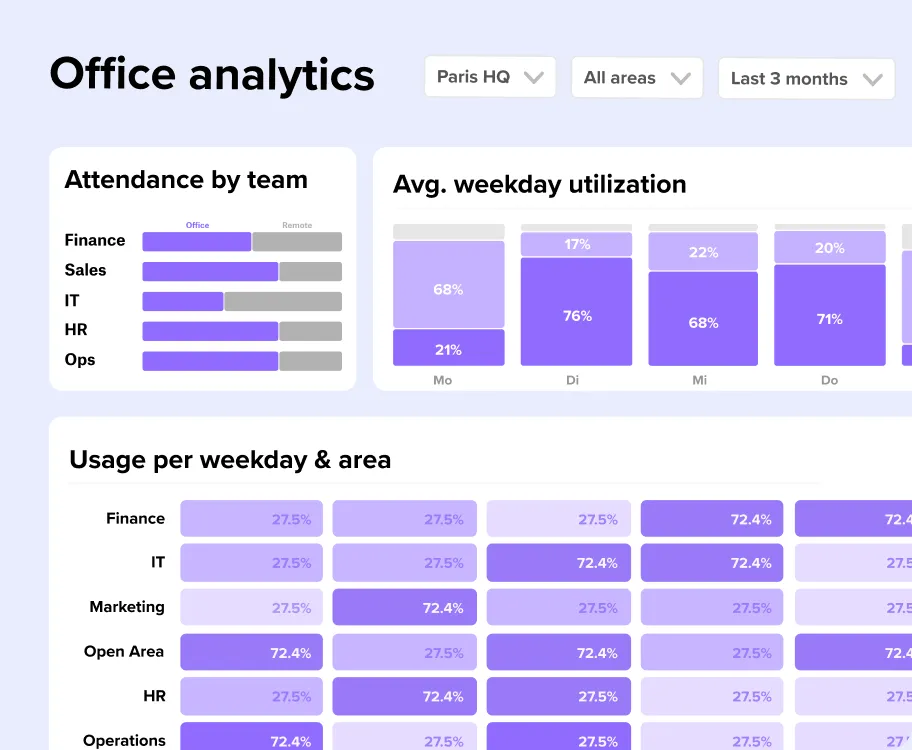
Measure your hybrid work success with deskbird
- Prove office ROI with attendance and utilization reports
- Collect qualitative feedback on team habits, attendance behavior, and what’s driving engagement
- Gain clarity on how every desk, room, or zone is used to improve your workplace strategy
Trusted by 100,000+ employees worldwide