

Office ROI: how to calculate the real cost of your hybrid workplace
Most workplace leaders can recite their annual lease cost down to the dollar, but ask them whether that space delivers measurable value and the conversation stalls. Office ROI connects what you spend on real estate to what you actually get back in productivity, retention, and collaboration, yet hybrid work makes this calculation harder because attendance shifts daily and traditional metrics like badge swipes miss how space is really used.
TL;DR
Office ROI measures whether your workspace generates enough value to justify what you spend on it. Most organizations struggle to prove this because they track the wrong things or lack visibility into how space is actually used.
What is office ROI?
Office ROI is the return your organization gets from its workspace investment. You calculate it by comparing the value your office generates to the total cost of running it. Value includes productivity, employee retention, collaboration quality, and how quickly teams get work done.
Why does this matter? Your office is likely one of your largest operating expenses. If you cannot prove the space delivers value, you cannot defend the budget. Hybrid work makes this harder because attendance fluctuates daily. You need to know exactly how and when employees use the office to justify what you spend.
Senior decision makers want concrete data before approving real estate budgets. They need to see reduced costs, measurable space efficiency, and proof that any tools you use will actually get adopted. To give them that, you need to understand both sides of the ROI equation: what you spend and what you get back.
The office ROI equation for cost and value
A simple formula captures office ROI: value generated minus total cost, divided by total cost. The challenge is defining each side accurately.
Most organizations know their costs. They track lease payments, facilities, IT infrastructure, and services like catering. Fewer organizations track the value side with the same rigor. Value includes productivity gains, employee retention, collaboration quality, speed of output, and your ability to attract talent.
[Table1]
Hybrid work adds complexity to both sides. You often pay for space that sits empty on certain days, which drives up your cost per seat without delivering additional value. Your operating model choices also affect the equation. A traditional lease carries different costs than flexible space. Homegrown spreadsheets require more IT resources than a dedicated platform.
Measuring both sides accurately starts with tracking the right metrics.
Office ROI metrics that prove space and productivity impact
You need metrics that show how your space actually performs.
Traditional occupancy counts miss the nuance of hybrid work. Someone badging into the building does not tell you whether they found a desk, collaborated with their team, or left after an hour.
- Utilization rate measures the percentage of available desks or rooms actually used during a given period. This reveals whether you have too much or too little space.
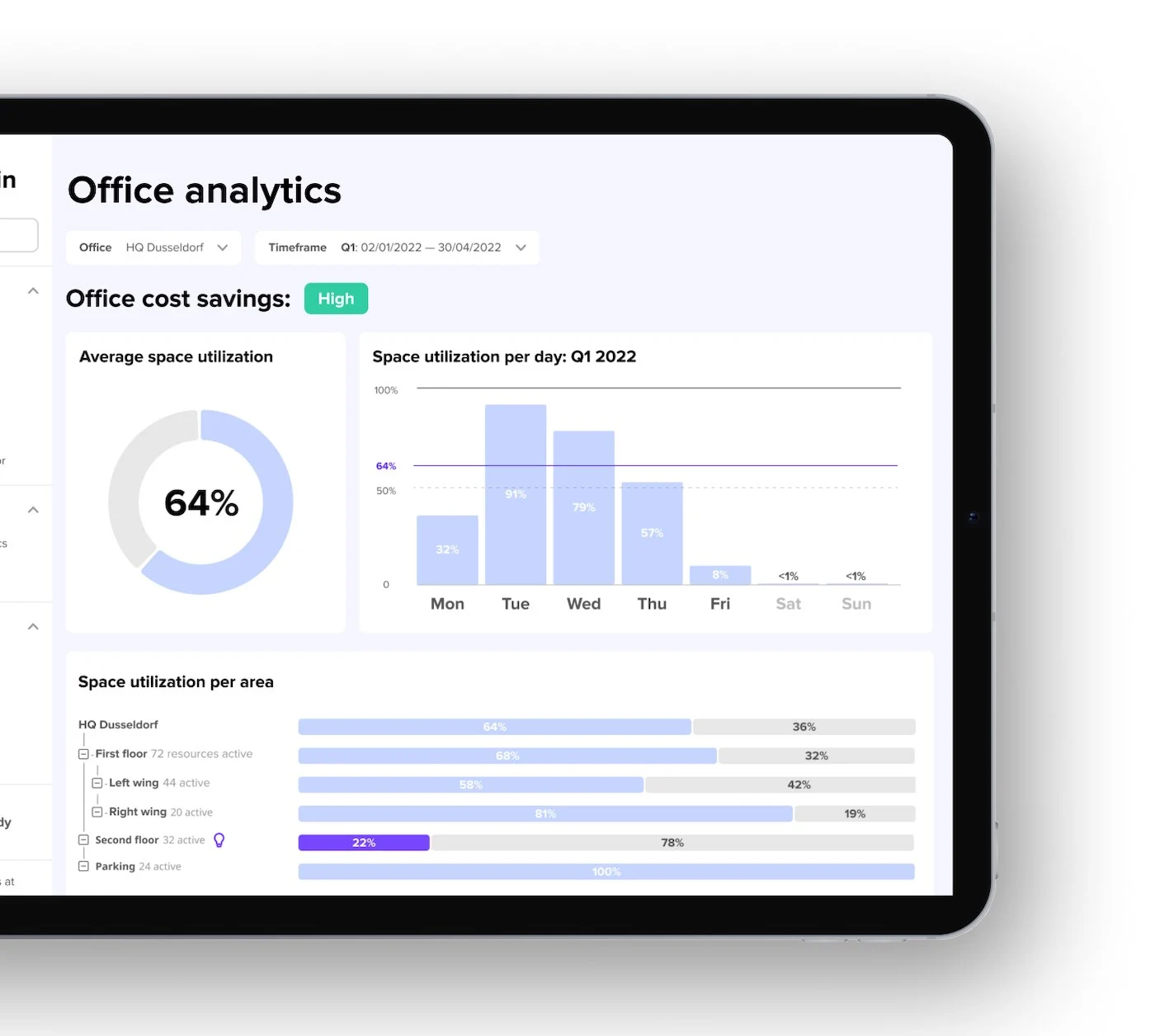
- Peak day analysis identifies which days see the highest demand, helping you plan capacity and avoid over-provisioning for quiet days.
- No-show rate tracks bookings that do not result in check-ins. High no-shows mean you are holding space that could be released to others.
- Booking-to-attendance ratio compares planned attendance to actual attendance, which proves useful for forecasting and policy enforcement.
- Collaboration density measures how often teams are in the office together, indicating whether your space supports the collaboration you want.
These metrics require visibility into booking and attendance data. Many organizations rely on badge swipes or manual headcounts. Both miss how space is actually used throughout the day.
Utilization and demand signals
Interpreting utilization, peak days, and no-shows together gives you the full picture. High occupancy combined with high no-shows suggests a booking discipline problem rather than a space shortage. Low peak-day utilization usually means you can reduce your footprint or consolidate floors.
Consider a common scenario. Your booking data shows consistent low demand on Fridays, averaging just 34.5% occupancy globally. You can close a floor or reduce services that day, cutting costs without affecting the employee experience. You need reliable data sources to make these decisions: booking platforms, sensors, and calendar integrations all provide the necessary information.
Step-by-step: how to measure office ROI
Building a reliable measurement process requires a structured approach. Start by defining your scope and timeframe. Decide what you are measuring, whether a single location or your entire portfolio, and over what period. Align this with your budget cycle or lease renewal timeline.
Next, establish your cost baseline. Aggregate all workspace costs including lease, facilities, IT, services, and any underutilization costs. Use a per-seat or per-square-foot metric so you can compare across locations.
Then identify the value drivers that matter to your business. Not every organization values the same outcomes. Prioritize 2 to 3 drivers like retention or collaboration frequency and define exactly how you will measure them.
Collect utilization and attendance data using booking systems or sensors. Integrate with calendar tools to see planned versus actual attendance. Build scenarios and compare what happens if you reduce space, change hybrid policies, or invest in better amenities. Compare the ROI under each scenario.
Finally, communicate results to stakeholders. Translate findings into cost savings, productivity impact, and risk reduction. Use visuals to make the case to leadership.
Define scope and baseline
Scope matters when establishing your baseline. Measuring a single floor requires a different approach than measuring a global real estate portfolio. Your hybrid work policies directly affect utilization patterns and must be factored into your baseline.
Your baseline should capture steady-state operations. Avoid using a month with major holidays or unusual company events. This ensures your data reflects normal working conditions.
Build the ROI model and communicate results
Your ROI models should include sensitivity analysis. What happens if utilization drops? What if employee retention improves? This helps leadership understand the full range of possible outcomes.
The best ROI presentations tie space decisions directly to business outcomes rather than just cost savings. Reducing your footprint by one floor saves money that you can reinvest in better collaboration spaces. Ongoing reporting keeps your ROI visible and supports continuous improvement.
6 tips for maximizing your office ROI
How to implement office ROI tracking with deskbird
Tracking office ROI requires accurate data and high employee adoption. deskbird provides an all-in-one workplace management platform that makes hybrid work simple for employees and transparent for leadership. Employees can book desks, rooms, and parking spots in just a few clicks directly from MS Teams, Slack, or Outlook.
This high adoption rate generates precise data for workplace analytics. You gain complete transparency into office behavior: peak days, busiest zones, and actual demand for resources. The platform integrates with over 100 tools, including major HRIS platforms like Personio and SAP, allowing you to export reports to BI tools like Power BI or BigQuery.
The Dynamic Spaces feature automatically limits bookable resources on low-usage days to generate immediate cost and sustainability gains. Security and privacy remain central to the platform. deskbird is built and hosted entirely in Europe, meeting enterprise standards out of the box as a GDPR-compliant, ISO 27001, and SOC 2 Type II certified solution.
Turn office ROI insights into action
Measuring office ROI is only valuable if you act on what you learn. deskbird gives workplace leaders the visibility they need to understand how space is used, identify waste, and make data-backed decisions about real estate.
The platform helps you see which days and zones are in high demand. You can spot no-shows, identify underutilized resources, and right-size your footprint with confidence. This allows you to support your hybrid policy with real attendance data.
Ready to turn office data into ROI you can defend? Book a demo.
Related content

Frequently Asked Questions
How do you calculate office ROI for a hybrid workplace?
What metrics should workplace leaders track for office ROI?
Why is office ROI harder to measure when attendance fluctuates daily?
Is deskbird SOC 2 Type 2 compliant?
Yes. deskbird is SOC 2 Type 2 compliant. The audit covers the core workplace management platform, including desk booking, room booking, and visitor management. The full report is available on request for organizations conducting vendor security reviews.
See exactly what your office is worth
- Track utilization, no-shows, and peak days in one place
- Right-size your footprint with data your leadership can act on
- Book a demo and see how deskbird turns office data into clear ROI