
How to build a workplace strategy that improves space usage and reduces cost
From deskbird's experience from more than 10'000 offices in over 80 countries, we've seen companies waste 30-40% of their office space because they guess at capacity instead of measuring it, then wonder why employees stop showing up when desks are full on Tuesdays and empty on Fridays. This guide walks you through building a workplace strategy that connects your space, policies, and tools to actual usage patterns so you can right-size your footprint, coordinate team attendance, and make the office worth the commute.
TL;DR
A workplace strategy is the plan that connects your office space, policies, and technology to how people actually work. It turns the office from an obligation into a destination worth the commute.
- Start with utilization data, not assumptions about how much space you need
- Policies only work when the tools that support them are easy to use
- The best strategies evolve quarterly based on what attendance patterns reveal
What is a workplace strategy
A workplace strategy aligns your physical office, work policies, and technology with your business goals. You decide how much space you need, when people should be on-site, and what tools help them coordinate.
Think of it as the operating model for your office. Workplace design focuses on furniture and floor layouts. Strategy goes deeper: it answers why people come to the office and how the space supports their work.
A complete strategy covers 4 areas:
- Space portfolio: Your office locations, desk counts, and room inventory
- Workplace policies: Rules about hybrid schedules, team anchor days, and on-site expectations
- Enabling technology: Tools for booking desks, finding colleagues, and tracking usage
- Employee experience: How all of this supports productivity, collaboration, and well-being
Most companies have pieces of a strategy scattered across HR, facilities, and IT. Connecting them into something coherent is the real challenge.
Why workplace strategy matters for hybrid teams
Hybrid work creates a coordination problem that traditional offices never faced. When people split time between home and office, you need a plan for who works where and when. Without one, you pay for empty desks on Fridays, the quietest day at 34.5% occupancy, and run out of meeting rooms on Tuesdays.
The stakes are real. Office space is typically the second-highest expense after employees. If your space sits half-empty most days, you are wasting money. Plus, if employees show up and cannot find their team, they stop coming. All this matters when you're trying to measure and maximize the ROI of the office.
A clear strategy delivers specific outcomes:
[Table1]
Making the office worth the commute is the goal. That requires knowing what brings people in and removing the friction that keeps them away.
How to build a workplace strategy step by step
Building a strategy takes alignment across departments and a willingness to adjust as you learn. You cannot copy another company's approach because your culture and operational needs differ.
1. Define your business goals first
Start with what the organization needs to achieve. Are you trying to cut real estate costs? Support headcount growth without adding space? Improve collaboration between teams?
Get leadership aligned before changing anything. If finance wants cost savings but HR wants maximum flexibility, your strategy will stall. A shared priority is essential.
Common goals include:
- Reducing real estate spend by releasing underused floors
- Increasing office attendance without mandates
- Supporting growth within existing square footage
- Improving cross-team collaboration
2. Gather employee input on work preferences
A strategy cannot be top-down only. You need to understand how people prefer to work. Survey employees to learn what brings them to the office and what keeps them home.
You might discover that sales teams need social spaces while developers need quiet zones. Different roles have different needs. Your strategy should reflect that.
Ask employees: Which days do you prefer to be on-site? What tasks bring you to the office? What would make the office more useful?
3. Audit your current space utilization
Data is the foundation of any corporate real estate workplace strategy. Many companies overestimate how much space they actually need because they rely on assumptions instead of measurements.
Track how your current space gets used before making decisions. You need to know your peak occupancy days, which meeting rooms sit empty, and how many desks go unused.
Key metrics to measure:
- Average daily attendance: Break this down by team to see who uses the space
- Desk utilization rates: Identify if you have too many desks or not enough
- Peak vs. low-traffic days: Understand the spread across the week
- No-show rates: Track how often booked spaces go unused
Workplace analytics tools automate this tracking. They give you the numbers to justify reducing desk counts or converting private offices into collaboration areas.
4. Set clear hybrid work policies
Policies turn your strategy into daily reality. You need to decide the rules: Will you require minimum in-office days? Will teams choose their own anchor days?
Clear policies prevent confusion. If leadership ignores the rules, employees will too. If employees do not know what is expected, they make their own rules. Managers start cutting side deals with their teams, and the official strategy falls apart. Attendance policies that are transparent and enforceable keep everyone aligned from day one.
Consider these policy elements when building your framework. Start by defining any company-wide mandate for required days, whether that's two days per week or specific anchor days everyone follows. Next, designate team anchor days where specific departments overlap on-site, ensuring collaboration happens naturally rather than by accident. You also need to clarify which roles qualify for hybrid arrangements through eligibility criteria, since customer-facing positions might have different requirements than knowledge workers. Finally, establish a clear exception process for handling full-remote requests so managers have consistent guidelines when employees need flexibility beyond the standard policy.
5. Choose workplace management tools
Technology enables the strategy to function. In a hybrid office, employees cannot rely on assigned seating. They need a way to see who is in the office, book a desk near their team, and find an available meeting room.
Prioritize tools that integrate with systems your team already uses: MS Teams, Slack, Outlook, Google Calendar. If the tool feels like extra work, people will skip it.
Look for these capabilities:
- Real-time booking: Reserve desks and rooms instantly via mobile or desktop
- Interactive floor plans: Visual maps showing where colleagues sit
- Calendar integrations: Sync bookings directly with work calendars
- Analytics dashboards: Reports on utilization and attendance trends
High adoption generates better data. Better data leads to smarter decisions about space.
6. Launch, measure, and iterate
Launch is not the finish line. Once you implement your strategy, communicate the changes clearly. Explain the "why" behind new policies so employees understand the reasoning.
Track adoption metrics continuously and review your data quarterly. If Friday attendance stays near zero, consider closing a floor that day to save energy costs. If meeting rooms are constantly overbooked, you might need more collaboration space.
Track these metrics post-launch:
- Tool adoption rates
- Employee satisfaction with the office experience
- Changes in space utilization
- Policy compliance
A strategy is a living thing. The best ones evolve based on what the data reveals, the same principle that underpins effective office space optimization.
What drives employee adoption of workplace tools
The best strategy fails if employees ignore it. Adoption is the biggest hurdle in modern workplace strategy. If booking a desk feels like a chore, people will not do it. If policies seem unfair, they will work around them.
Removing friction is what drives adoption. When tools are intuitive, employees use them naturally. This generates the data you need without forcing compliance.
Focus on these drivers:
- Simplicity: Booking a desk should take seconds, not minutes
- Visibility: Employees want to see where their colleagues are sitting
- Fairness: Policies should apply consistently across all teams
- Value: The office experience must be better than working from home
The social element matters more than mandates. When people can see that their favorite colleagues will be on-site, they want to come in. That visibility drives attendance more effectively than rules.
Tools that support workplace strategy execution
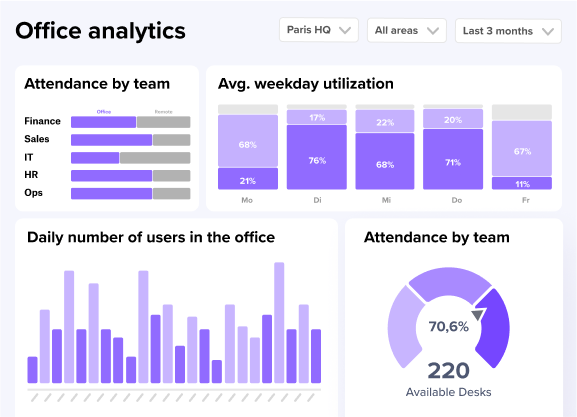
You cannot manage a flexible workforce with spreadsheets. You need specific tools to handle the logistics of who sits where and when. Three categories of tools form the foundation:
Desk Booking lets employees reserve workspaces and see colleague locations. This reduces the need for assigned seating and helps teams sit together on the days that matter. Room Booking manages meeting room availability and reduces conflicts. It cuts down on double bookings and ensures rooms match meeting needs. Workplace Analytics tracks utilization, attendance, and booking patterns. This provides the data needed to inform space planning and adjust policies.
These tools work best when they talk to each other. If someone books a desk, the system should know they are in the office. If they have a meeting, it should suggest a nearby room.
deskbird combines all three in one platform. It integrates with MS Teams, Slack, Outlook, and Google Calendar so employees can book in 2 clicks without leaving their workflow. The analytics show exactly how your space gets used, giving you the data to right-size your footprint.
Workplace strategy recap and next steps
A successful workplace strategy aligns your space, policies, and tools with how people actually work. It moves away from rigid assigned seating toward a flexible model that supports hybrid teams.
Start by auditing your current utilization. Ask employees what they need. Use that data to build policies and select tools that make hybrid work easy. This is an iterative process: review quarterly and adjust based on what you learn.
The office should be a deliberate destination, not an obligation. When you give employees clarity on where their colleagues will be and make booking simple, attendance follows naturally.
If you want to right-size your office with real utilization data, book a demo.

Frequently Asked Questions
What does a workplace strategy consultant do for hybrid offices
How do you measure whether a workplace strategy is working
What is the difference between workplace strategy and workplace design
How often should you update your hybrid workplace strategy
What tools do you need to execute a workplace strategy
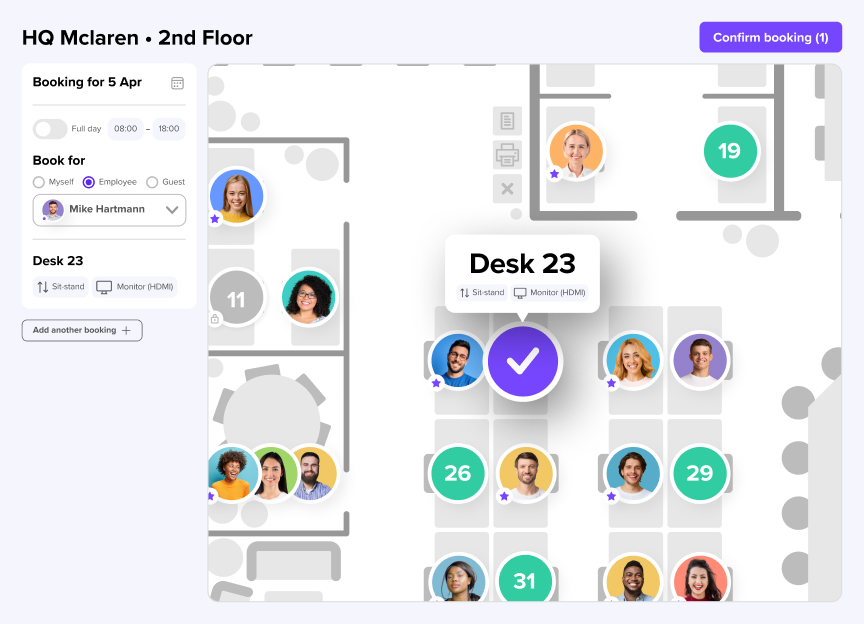
See exactly how your office space is really being used
- Most offices waste 30-40% of their space by guessing instead of measuring.
- Real utilization data shows which desks, floors, and days to cut first.
- Book a demo and see your office usage in one clear dashboard.
