How to design a successful hybrid work policy
Learn what a hybrid work policy should include, see real company examples, and get a step-by-step guide to writing and rolling one out.

A hybrid work policy is the official document that defines how flexible work is organized at your company. It covers eligibility, schedules, communication standards, equipment, equity safeguards, and compliance. Effective policies are clear, consistently applied, and reviewed regularly. Use a structured rollout plan and involve managers early to drive adoption.
Key takeaways:
- The most effective policies clearly define eligibility, expected office attendance, and compliance and WFH safety requirements.
- Build fairness into your policy with consistent performance metrics, equal access to opportunities, and clear communication.
- Treat your policy as a living document and review and update it regularly to make sure it stays up to date and relevant.
What is a hybrid work policy?
A hybrid work policy is the official company policy that governs hybrid work at an organization. Unlike a guideline, which is a recommendation, a policy is enforceable: employees and managers are expected to follow it. It’s the formalized set of guidelines that define how hybrid work is organized and managed, covering everything from definitions of hybrid work to eligibility criteria to required in-office days to health and safety in the hybrid workplace.
Creating and implementing a hybrid office policy is crucial because it avoids common pitfalls with flexible work arrangements. According to Gallup, unclear policies are among the top challenges hybrid employees face, affecting coordination, fairness, and engagement across teams. A well-designed policy addresses this by providing:
- Consistency: A proper policy ensures that all employees and managers follow the same rules.
- Legality: Clear hybrid policies help organizations comply with labor laws, workplace safety regulations, and data security requirements.
- Equality: Standardized policies promote fairness by guaranteeing that all employees have equal access to opportunities, resources, and flexibility.
- Clarity: A formalized framework reduces misunderstandings and avoids confusion by clearly stating expectations and procedures.
- Accountability: Clearly defined rules make it easier to evaluate compliance and address issues if the policy is not followed.
- Trust: Implementing a policy that is applied consistently signals transparency and builds confidence in employees that the policy isn’t being applied arbitrarily.
What are some hybrid work policy examples?
Company-wide hybrid work agreements come in many shapes and forms. Here are some hybrid working policy examples to take guidance from.
- Dell Technologies: Dell Technologies allows employees to choose their work style—remote, office-based, or hybrid—to support mobility, collaboration, recruitment, sustainability, and business resilience. Dell’s hybrid work policy outlines eligibility criteria, expectations for communication and productivity, technology support provisions, and guidance for managers on assessing and approving requests.
- University of Cambridge: The University of Cambridge offers an optional hybrid model combining on-site and UK-based remote work, with eligibility based on role tasks and operational needs. The policy includes clear procedures for agreeing arrangements, performance and conduct standards, health and safety requirements for remote environments, and safeguards to ensure equal access to opportunities regardless of work location.
- Fordham University: Fordham University offers hybrid (and rare fully remote) work to eligible administrators, emphasizing that flexibility should not compromise productivity or mission. The policy includes clear eligibility rules, approval procedures, technology safeguards, and termination clauses.
What to include in a hybrid work policy?
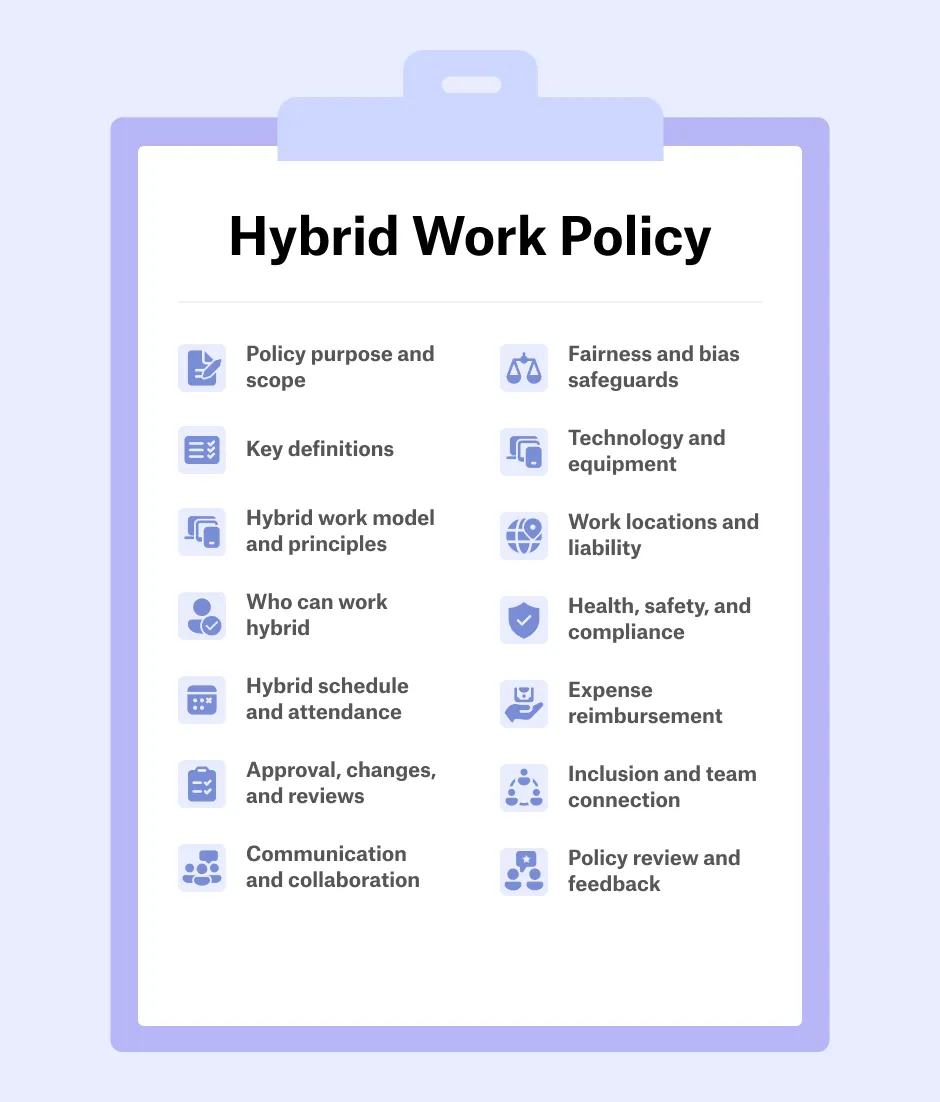
A hybrid work policy should cover several core elements: purpose and scope, definitions, hybrid model and guiding principles, eligibility criteria, schedule and attendance guidelines, approval and review clauses, communication standards, equity safeguards, technology and equipment, health and compliance requirements, expense reimbursement, and inclusion and culture guidelines.
Hybrid work policies should include certain core elements, such as eligibility criteria, hybrid work model and schedule, communication standards, and work location rules. They should further provide definitions for key concepts and guidelines for aspects like health, safety, wellbeing, and compliance.
Purpose and scope of the policy
The initial section of a hybrid work policy should clarify aspects like:
- Why your organization has adopted a hybrid work model,
- How the policy aligns with your company values and goals, and
- Which company locations, departments, teams, or roles are covered by the policy.
Definitions
The “Definitions” section should explain the meaning of key policy terms like hybrid work, remote work, in-office days, core hours, primary workplace, and “work from anywhere” days (if applicable). It’s also worth clarifying distinctions between similar concepts (e.g., remote-only vs. hybrid) to avoid misunderstandings.
Hybrid work model and guiding principles
Outline the broader framework on which the policy is based and deliver a short description of your organization’s hybrid work model (e.g., remote-first, fully flexible, or fixed hybrid) as well as the guiding principles behind it (e.g., trust, accountability, inclusivity, performance over presence).
Hybrid work eligibility criteria
Clarify the criteria employees must meet to qualify for hybrid work, such as job duties, location, tenure, or performance. You can either list roles that must remain on-site or those that are remote-eligible. In any case, explain the process for requesting a hybrid arrangement to ensure transparency and consistency.
Hybrid work schedule and attendance guidelines
Your policy should clearly define your company’s hybrid work schedule and expectations for in-office presence. Depending on your chosen hybrid model, this may include:
- Required number of in-office days (e.g., 2–3/week),
- Core working hours and flexibility for start/end times,
- Guidelines for compressed or flexible workweeks, and
- Office/remote day split and scheduling expectations.
Approval, revocation, and review clauses
Clearly define how hybrid arrangements are approved, revoked, and reviewed. Approval clauses specify who authorizes schedules, how requests are submitted, the criteria for approval, and timelines for responses. Revocation clauses describe when hybrid status can be withdrawn (e.g., due to performance issues) along with notice periods and escalation steps. Review clauses set expectations for how often arrangements are reassessed and how changes are documented for transparency.
Communication guidelines
Include clear expectations for responsiveness (e.g., replying to urgent emails within four hours) in your policy and specify required tools, such as email, Slack, MS Teams, or project management software. Also define meeting etiquette and documentation standards to keep collaboration consistent.
Equity and presence bias safeguards
An effective hybrid work policy should include equity safeguards to prevent presence bias and ensure equal access to opportunities for remote and on-site employees. This means evaluating performance based on measurable outcomes and clear KPIs instead of physical presence. Key safeguards include manager training on fair assessments, regular audits of meeting participation, and transparent promotion criteria.
Technology and equipment
Define what technology and equipment your company provides (e.g., laptops and monitors) and what employees are expected to supply themselves. Include minimum standards for internet connectivity, security requirements (e.g., VPN use), and the process for requesting technical support. If you use tools like deskbird for desk booking, ticketing or office analytics, mention them here so employees can easily navigate hybrid workspace logistics.
Work locations and liability
Work location rules specify approved work environments, such as home offices, coworking spaces, or other third workplaces. As part of your hybrid policy, they should also describe the process for temporarily working from a new location and outline how liability is managed when employees work off-site.
Health, safety, wellbeing, and compliance
Set clear rules for safe, ergonomic workspaces, mental health support, and in-office health protocols. Cover compliance essentials like data protection, confidentiality, health and safety standards, equipment obligations, and any cross-border legal requirements, such as compliance with regional hybrid work policies.
Expense reimbursement
Your policy should spell out which hybrid work expenses will be covered by your company (e.g., home internet or office supplies) and how employees can submit claims for approval. If relevant, clarify rules on commuting costs or parking, and explain what support is available for setting up a productive home workspace.
Inclusion, culture, and team connection
To foster a strong, inclusive culture, your policy should highlight strategies like giving everyone a voice in meetings, mixing virtual and in-person team-building, and celebrating wins across all locations. These practices help keep connections strong and prevent silos between remote and office-based staff.
Policy review and feedback
Make it clear how often the policy will be reviewed (e.g., once or twice a year) and how you’ll gather employee feedback, like through surveys or dedicated channels. Explain how changes will be made in response to shifting business needs, new regulations, or evolving employee expectations, so the policy stays relevant and effective.
How to create and manage hybrid work policies with deskbird
With deskbird, you can easily create and manage hybrid work policies and ensure that your teams follow them. With flexible rules, approval workflows, and reporting tools, managers save time while ensuring fairness, compliance, and team alignment.
- Create and customize policies: Define required on-site or remote days, set minimum/maximum ranges, and fixed in-office days.
- Assign policies easily: Apply rules company-wide, by team, or by individual, with exemptions for specific users.
- Approval workflows: Choose between no approval flow, full manager approval, or approvals for exceeded remote days only.
- Custom status settings: Decide how activities like training or business trips count (on-site or remote).
- Manager view: Access a full team overview, approve or reject schedules, and monitor compliance from a single dashboard.

How should you communicate a hybrid work policy to employees?
To effectively communicate and distribute your hybrid work policy, use a structured communication plan and different channels, and train team leads and managers early to turn them into policy advocates. From the first announcement to ongoing reminders, employees need easy access and clear explanations.
1. Distribute your policy effectively
- Targeted email launch: Send a company-wide announcement with a direct link to the policy and a short summary of key aspects.
- Multiple formats for easy access: Share the policy digitally via your intranet, HR portal, or document management system, and include it in your employee handbook.
- Official version hub: Host the official, current version in a dedicated location that is easily accessible.
2. Train managers for policy use
- Manager-first approach: Roll out the policy to managers before the general announcement so they can answer employee questions with confidence.
- Training with real-life examples: Provide real examples for policy application (e.g., how to approve schedule changes).
- Performance tracking: Show managers how to translate policy guidelines into performance management to reduce the risk of presence bias.
3. Define a clear rollout plan
- Kick-off sessions: Host virtual and in-person info sessions where leadership explains the “why” behind the policy and its benefits.
- Staggered communication: Reinforce the message through multiple touchpoints over a few weeks, including newsletters, team meetings, and internal chats.
- Interactive Q&A sessions: Offer live or recorded sessions so employees can clarify doubts in real time.
4. Establish points of contact
- Designated policy ambassadors: Assign HR representatives or trained managers as go-to contacts for policy-related questions.
- Clear contact details: Include names, roles, and email addresses of these people so that employees can approach them for clarifications.
- Feedback loop: Offer an easy channel (e.g., anonymous survey or form) for employees to share their experiences and suggest improvements.
5. Keep policy awareness up
- Ongoing reminders: Mention key policy elements in team meetings, performance reviews, and during onboarding sessions for new hires.
- Policy updates: When changes occur, communicate them as clearly and visibly as the original rollout. Don’t just upload a new PDF.
- Celebrate adoption: Share success stories of how the hybrid model benefits teams and individuals to spin a positive narrative around it.
We need a more complex approach and a lot more individualization. Acceptance increases significantly because employees feel their employer is trying to understand and reflect their situation.
– Prof. Johanna Bath, Hybrid Work Expert, Author, Speaker & LinkedIn Top Voice
Get your free hybrid work policy template
Setting up a hybrid work policy for the first time can be a daunting and time-consuming task, especially since you need to make sure nothing gets overlooked. Having a detailed checklist at hand helps you make sure that you’ve got everything covered. Download our free hybrid work policy checklist to get step-by-step guidance for creating a successful hybrid work agreement.
Conclusion: A successful hybrid work policy is built on fairness, clarity, and iteration
Designing a hybrid work policy is about building a clear, fair, and adaptable framework that works for both your business and your people. Effective policies cover the essentials (purpose, scope, eligibility, schedules, etc.) while leaving room for regular reviews and improvement.
Managers play a crucial role in making hybrid work policies succeed. That’s why in the next chapter, we’ll shift the focus to hybrid work leadership. Read on to learn how to set clear expectations, build trust, and measure success based on outcomes to make your hybrid model thrive in day-to-day operations.
Hybrid Work Policy FAQs
What is a hybrid work arrangement policy?
A hybrid work arrangement policy spells out how employees split their time between remote and on-site work. It defines eligibility, schedules, performance expectations, and equipment standards, ensuring clarity and consistency while supporting both business goals and employee flexibility.
What is an example of a hybrid work policy?
An example is Dell Technologies’ Connected Workplace program, which lets employees choose remote, office-based, or hybrid setups. It includes eligibility rules, communication expectations, technology provisions, and guidance for managers, ensuring productivity, collaboration, and security across all work locations.
How do you write a hybrid work policy?
Start by defining purpose, scope, and eligibility. Outline schedules, performance expectations, equipment and security requirements, and procedures for approvals and changes. Include equity safeguards, communication standards, and legal compliance. Use clear language, consult stakeholders, and plan for regular policy reviews.
Do all employees have to be treated equally under a hybrid work policy?
Equal treatment is essential, but “equal” doesn’t always mean identical. Decisions should be based on role requirements and operational needs, not personal bias. A good policy ensures fair access to opportunities, resources, and recognition for both remote and in-office staff.
What's the difference between a hybrid work policy and a hybrid work guideline?
A policy is a formal, enforceable document with rules employees must follow. For example, "team members must work on-site at least 2 days per week." A guideline is a recommendation without binding consequences. For example, "we encourage at least one office day per week." Policies create accountability. Guidelines create intent. Most organizations need both: a policy for compliance and guidelines for flexibility within it.

Effortlessly manage hybrid work policies with deskbird
- Create tailored in-office or remote work policies at the individual, team, or company level
- Quickly review and confirm if employees have met policy requirements
- Analyze your team’s in-office and remote days to adapt your policies
Trusted by 100,000+ employees worldwide