

How to achieve hybrid policy compliance without surveillance
Most organizations announce a hybrid work policy and assume employees will follow it, but workplace leaders rarely have reliable data to confirm who actually shows up on required days. Hybrid policy compliance gives you clear visibility into whether your attendance rules work in practice. You can use booking data and voluntary check-ins to see patterns without resorting to surveillance tools that erode trust and often produce unreliable data.
TL;DR
Hybrid policy compliance means employees follow your in-office attendance rules and you have the data to prove it. You can track this without surveillance by using booking data and voluntary check-ins instead of monitoring software.
- Use desk bookings and voluntary check-ins as your attendance data
- Build policies around clear expectations, not vague guidelines that leave room for interpretation
- Diagnose low compliance as a system problem before treating it as a people problem
What is hybrid policy compliance?
Hybrid policy compliance is when employees meet the attendance expectations your organization sets and workplace leaders have visibility into whether that happens. You know who comes to the office, when they come, and whether your hybrid work policies are actually working.
Most organizations write hybrid work policies without much trouble. Knowing if anyone follows them is the hard part. Without clear data, you end up making real estate decisions based on guesses. You keep office space you do not need or cut space that teams actually use.
Compliance works when 3 things happen at the same time:
- Employees come in on the required days
- Workplace teams can see attendance patterns without manual tracking
- Rules apply consistently, so managers use objective data instead of gut feelings
What should a hybrid work policy include?
A hybrid work policy is a written document that explains when employees need to be in the office and how the organization will track attendance. This document removes guesswork for everyone involved. When expectations are clear, compliance becomes much easier to measure.
Attendance requirements and flexibility parameters
Your policy needs to define exactly what a required office day looks like within your hybrid work schedule. Specify whether employees need to be in the office a certain number of days per week or on specific anchor days. Some organizations use a fixed schedule where everyone comes in on Tuesday and Thursday. Others let teams choose their own days as long as they hit a minimum.
Flexibility parameters explain who can request changes and how. Document the process for exceptions so employees know what qualifies and who to ask. Without this clarity, managers end up making inconsistent decisions that feel unfair.
Communication standards and meeting protocols
Hybrid teams need clear rules for how they communicate across locations. Establish norms for asynchronous updates, expected response times, and virtual meeting etiquette. These standards reduce friction and make compliance feel like a natural part of the workday.
When communication rules are vague, employees struggle to know what counts as being present. Someone working from home might feel like they are meeting expectations while their manager thinks otherwise. Clear protocols prevent these misunderstandings.
Performance measurement and accountability
Compliance tracking should focus on outcomes rather than surveillance. Explain how managers will measure performance fairly regardless of where an employee works. Accountability means giving managers the data they need for constructive conversations instead of creating gotcha moments.
The goal is to make attendance visible without making employees feel watched. When people understand that the organization cares about results and team coordination, they are more likely to follow the rules willingly.
Technology requirements and IT support
Employees need the right tools to comply with your attendance rules. List the workplace management platform, calendar integrations, and check-in methods your team will use. IT plays a crucial role in provisioning access and ensuring these tools integrate smoothly with MS Teams, Slack, Outlook, and Google Calendar.
For IT teams evaluating tools, the key questions are maintenance burden and integration reliability. You want System for Cross-domain Identity Management (SCIM) provisioning and single sign-on (SSO) out of the box so the system runs without ongoing attention. Native integrations with Microsoft Entra ID (Azure AD), Okta, and major human resources information system (HRIS) platforms reduce the risk of tool sprawl.
How to roll out hybrid work policies that employees actually follow
Announcing a policy once and expecting compliance is a recipe for frustration. A structured rollout plan helps employees build new habits over time. A thoughtful launch turns a written document into actual workplace behavior.
Start by communicating the policy through the channels employees already use daily. If your organization lives in Slack or Teams, that is where the announcement should happen. Email alone is not enough because people miss it or forget.
Give managers a toolkit before the launch date. They need talking points for team conversations, clear guidelines for handling exception requests, and an escalation path for edge cases. Managers who feel unprepared will either ignore the policy or enforce it inconsistently.
Make the first 30 days a feedback period. You will learn things you did not anticipate. The check-in process might be too clunky. Certain teams might have legitimate reasons for different schedules. Adjust the rules based on what you learn instead of doubling down on a flawed approach.
Require employees to acknowledge the policy in writing. This can happen through your HRIS or workplace management platform. A digital acknowledgment creates a clear record and signals that the organization takes the policy seriously.
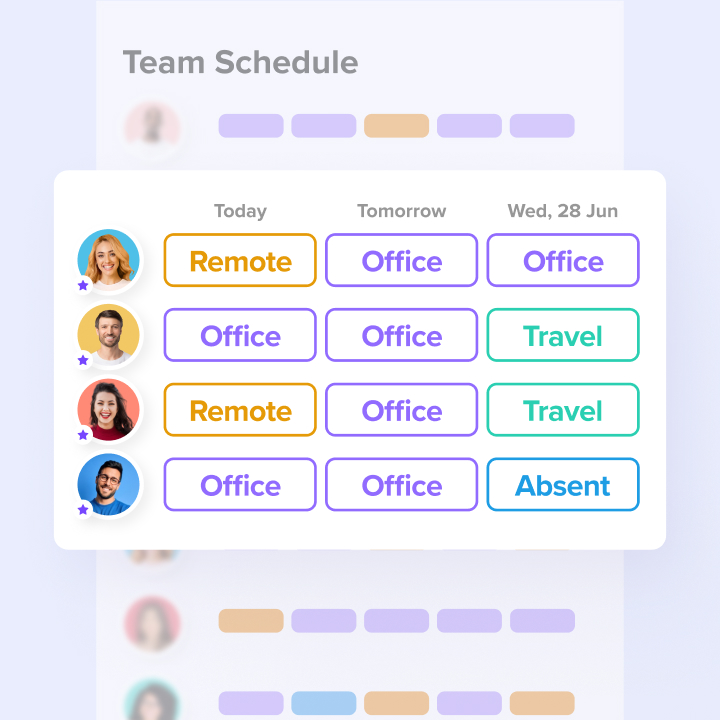
How to track hybrid policy compliance without employee surveillance
You do not need monitoring software, badge swipes, or keystroke logging to track office attendance. These surveillance methods erode trust. In one survey, monitored employees reported 45% higher stress levels. They can also create messy, incomplete data, for example when people badge in but do not stay. Booking data and voluntary check-ins give you a reliable source of truth that respects employee privacy.
The difference between surveillance and trust-based tracking comes down to what you measure and how you use it.
[Table1]
Good compliance data focuses on patterns rather than individual monitoring. You want to compare booked versus checked-in attendance by team, site, and day. This helps you identify which teams consistently meet expectations and which groups need additional support. The gap between planned attendance and actual attendance is where most policies fail. Employees book a desk on Monday but decide to work from home without canceling. By requiring a simple check-in upon arrival, you capture the true utilization rate of your office space.
You also need to spot no-show rates across the organization without naming individuals in reports. Team-level data gives managers enough information for conversations without creating a surveillance culture. Visibility is the goal, not punishment.
deskbird provides this visibility as a workplace management platform that supports desk and room booking, witht fast check-ins, and it integrates with your existing calendar apps. You get accurate utilization data without invasive tracking. For IT teams, the platform meets ISO 27001, SOC 2 Type II, and GDPR compliance standards with data hosted in the EU.
What to do when employees don't follow the hybrid policy
Non-compliance is usually a signal rather than a discipline problem. The policy might be unclear or the booking tools might create too much friction. Workplace leaders need a framework to diagnose the root cause before escalating.
- Start by determining if the absence is a consistent pattern or just a rare exception. One missed day does not equal non-compliance. A month of missed anchor days requires attention. Look at the data before jumping to conclusions.
- Check if the policy itself is clear. If multiple people are confused about the same rule, the policy needs rewriting. Widespread confusion is a documentation problem, not a people problem.
- Evaluate whether your workplace tools are actually working as intended. If booking a desk takes too many steps, compliance will naturally drop. People take the path of least resistance: when the system is hard to use, they skip it.
- Consider whether the employee has a legitimate exception. Some roles genuinely cannot follow standard attendance rules. Client-facing positions, field teams, and employees with caregiving responsibilities often need different arrangements. Build these exceptions into your policy from the start.
- Fair reporting means looking at team-level data instead of individual surveillance metrics. Managers should use this data to have a constructive conversation with the employee. The goal is to understand the barrier to attendance and find a practical solution.
How deskbird supports hybrid policy compliance
Enterprise organizations need a reliable way to coordinate hybrid work without adding administrative burden. deskbird serves as the coordination layer that hybrid teams need to function effectively. Employees can see who will be in the office before committing to a day, which builds sustainable in-office habits naturally.
Accurate utilization data is only possible if employees actually use your workplace tools. Across 500+ companies, deskbird customers report 90%+ adoption. The product is designed to work with the tools people already use, so most teams need little to no training. This high adoption bridges the gap between your written policy and your real estate decisions.
IT and Operations teams benefit from a secure, zero-maintenance infrastructure. deskbird is built and hosted in Europe, meeting strict ISO 27001, SOC 2 Type II, and GDPR compliance standards. Native integrations with HRIS platforms like Personio, SCIM auto-provisioning, and SSO make policy automation straightforward.
Workplace leaders can use deskbird to manage transparent attendance policies without resorting to enforcement. The platform provides analytics on office utilization, attendance patterns, and team presence. Real estate teams get the exact data they need to make confident space decisions.
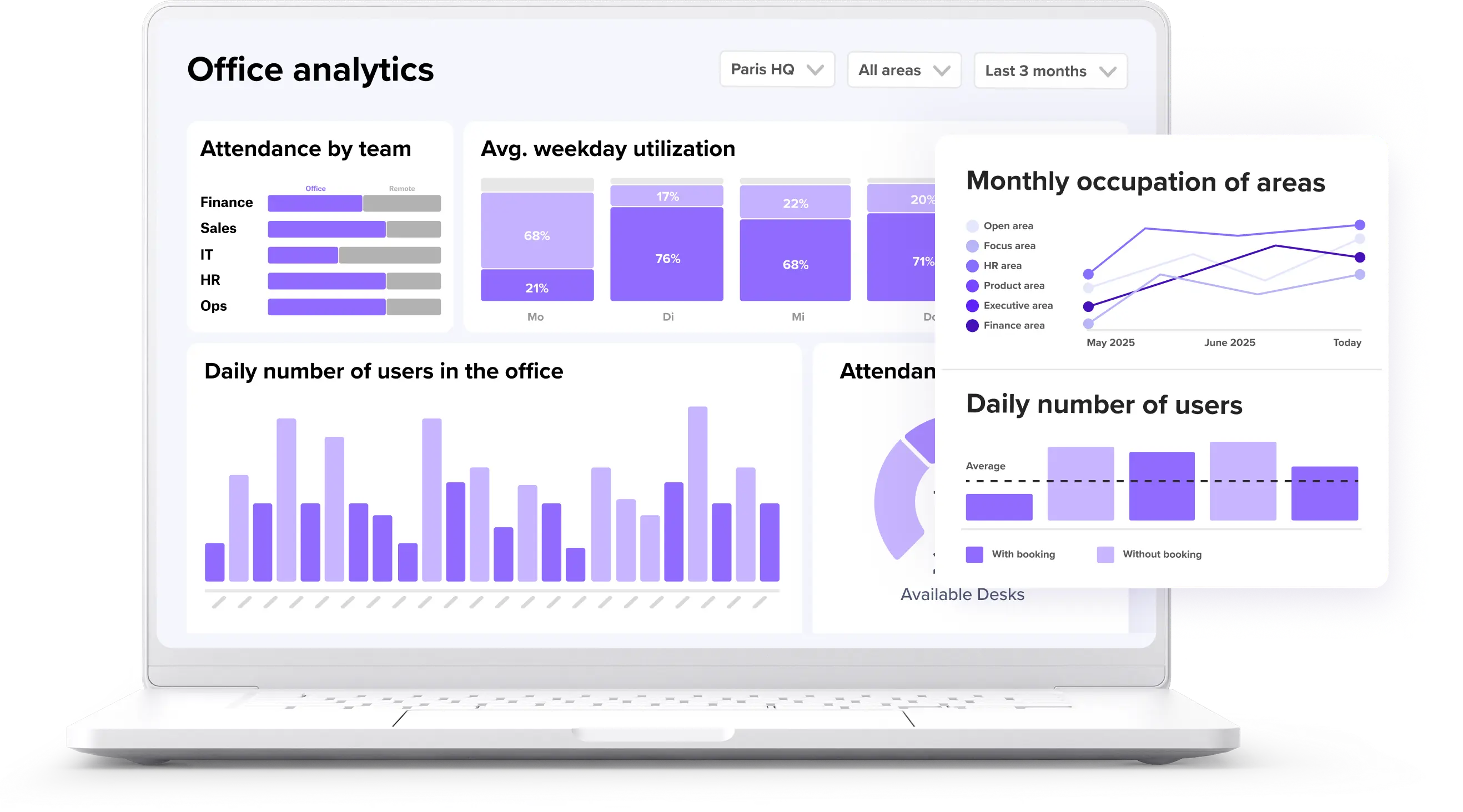
Make hybrid policy compliance simple for employees and visible for leaders
Compliance is a system design problem. When booking a desk is easy and check-ins are fast, compliance happens naturally. You need a structured approach that respects privacy while giving leadership defensible numbers.
Testbirds faced this exact challenge when the pandemic shifted their workforce to a hybrid model. They initially tracked office attendance using Excel spreadsheets, which proved inconvenient and outdated for managing who was working where and what equipment was available at each desk. After implementing deskbird with its MS Teams integration, the company achieved over 90% adoption with minimal training. Employees could plan their entire week in just a few clicks instead of navigating cumbersome spreadsheets.
Since deskbird can be integrated into MS Teams, it is quick and easy to use. deskbird gives employees a smooth booking experience for desks, rooms, and parking spots. Workplace leaders get accurate utilization data to right-size real estate and maximize office ROI. The platform makes hybrid work intentional without resorting to strict mandates or enforcement. See compliance in action: book a demo.

Frequently Asked Questions
How do you enforce a hybrid work policy fairly across different teams?
What is the best way to track office attendance without monitoring employee devices?
Use desk bookings and room bookings combined with voluntary check-ins. This approach provides accurate utilization data without keystroke monitoring, location tracking, or other invasive methods.
How do you handle exception requests for hybrid work policies?
What should you do if hybrid policy compliance drops after the first month?
See hybrid policy compliance without the surveillance
- Book a desk, check in, and track attendance patterns across teams automatically.
- 90%+ adoption across 500+ companies means your utilization data is actually reliable.
- ISO 27001, SOC 2 Type II, and GDPR-compliant, with data hosted in the EU.
