

Hybrid work statistics: What data says in 2026
Hybrid work is now the default model for knowledge-based organizations. Around 52% of remote-capable U.S. employees follow a hybrid schedule, according to Gallup. Stanford research confirms hybrid workers are just as productive as full-time office staff, while attrition falls by 33% when companies shift to hybrid. Office occupancy has stabilized at roughly 40–53% globally. Most employees value flexibility more than ever, but RTO pressure is real, and the gap between policy and actual attendance keeps widening.
Introduction
Hybrid work is now the dominant model for knowledge workers globally. But as it matures and wins as a model, the questions have shifted from "should we do it?" to "how do we do it well?". The gap between policy and practice is still wide: between employees who want flexibility and employers pushing for more office time, between companies paying for large offices and floors running at 40% occupancy, and between productivity evidence and executive instinct.
Here's what the data says.
How common is hybrid work in 2026?
Hybrid work is the dominant model for knowledge workers globally, with roughly half the remote-capable workforce now splitting time between office and home. According to Gallup's September 2025 report, approximately 51% of remote-capable U.S. employees follow a hybrid schedule, down slightly from 55% in early 2025 but stable compared to the broad trend since late 2022.
Key adoption figures:
- 52% of remote-capable U.S. employees work hybrid, per Gallup's Q3 2025 data
- 27% work fully remote; 21% are fully on-site
- 67% of organizations globally now operate some form of hybrid work
- 27% of companies require fully in-person work by end of 2025; 6% are fully remote
- 74% of UK organisations had a formal hybrid work policy in place in 2025, per CIPD
- 69% of companies with fewer than 500 employees offer location flexibility, compared to just 11% of large enterprises with over 25,000 employees
- 22% of the U.S. workforce (about 32.6 million people) worked remotely in 2025
What this tells you: Hybrid isn't growing explosively the way it did in 2022 and 2023. It's stabilizing, which is what happens when a model stops being an experiment and starts being standard practice. Most organizations have committed and moved on. The minority who reversed course to full-time office-only are a smaller group than headlines suggest.
What do employees actually want from hybrid work?
Employees overwhelmingly prefer hybrid schedules, and flexibility has moved from a perk to a baseline expectation in job decisions. Around 72–83% of workers globally say a hybrid setup is their ideal arrangement, according to multiple surveys.
More specific figures from recent research:
- 83% of workers globally say hybrid arrangements are ideal for balancing focus and teamwork
- 83% of employees rank work-life balance ahead of salary when evaluating roles
- 55% of job seekers rank hybrid as their top work arrangement preference; only 16% prefer a fully in-office role
- 40% of workers say they would start job hunting if flexible work were eliminated; 5% say they'd quit outright
- The average employee values hybrid flexibility at roughly 8% of their salary. They'd accept an 8% pay cut rather than lose the arrangement
- 65% of Gen Z prefer hybrid arrangements; only 23% want fully remote work
- 38% of professionals are already looking or planning to search for a new role in H1 2026
What this tells you: The "employees just want to work from home" narrative is oversimplified. People want balance, not distance. The most popular preference, consistently, is 2–3 days in the office. Gen Z, often assumed to be the most remote-friendly generation, actually favors hybrid more than older cohorts. They're drawn to mentorship, social connection, and in-person learning in ways their remote-native careers didn't provide.
Does hybrid work hurt productivity?
Hybrid work does not hurt productivity. A landmark study published in Nature in June 2024 by Stanford economist Nicholas Bloom found that employees working from home two days per week are just as productive and equally likely to be promoted as their fully office-based peers. The study, a randomized controlled trial of over 1,600 workers at Trip.com, is the largest rigorous test of hybrid work productivity to date.
Key productivity data:
- No difference in output or promotion rates between hybrid and fully in-office workers, per the Stanford Nature study
- Resignations fell by 33% among workers who shifted from full-time office to hybrid
- 90% of hybrid employees say they are as productive or more productive than when fully in-office, per Owl Labs
- 62% of managers say their team is more productive when working hybrid or remote, per Owl Labs
- 73% of employees report hybrid work makes them more productive
- Companies with hybrid and remote employees are 25% more likely to achieve exceptional growth versus purely in-office counterparts
- 35% of hybrid firms achieved double-digit annual revenue growth, compared to 28% of fully in-office companies
- Hybrid workers experience burnout symptoms 15% less frequently than in-office counterparts, per research from the IE Center for Health and Well-Being
What this tells you: The most common executive objection to hybrid ("we lose productivity") lacks empirical support. The Stanford Nature study is peer-reviewed, randomized, and large-scale. What it found is that productivity concerns were mostly in managers' heads. Before the study, managers predicted hybrid would reduce output. By the end, they'd changed their minds. For a deeper look at how hybrid models actually work in practice, see our hybrid work guide.

What does the return-to-office trend actually look like?
The return-to-office trend is real but often overstated. While more companies issued stricter RTO mandates in 2024 and 2025, actual attendance increased far less than policy changes suggest. Required in-office time rose by 12% between Q1 2024 and Q3 2025, but actual attendance increased by only 1–3% in the same period.
Current RTO landscape:
- 54% of Fortune 100 companies required full-time office work in Q2 2025, up from just 5% in Q2 2023
- 37% of companies actively enforced office attendance in 2025, up from 17% in 2024
- Average weekly in-office requirement for Fortune 100 employees rose from 2.6 days to 3.9 days between 2023 and Q2 2025
- In Germany, deskbird's Desk Sharing Index 2026, based on booking data from over 30,000 users across 8 cities, found that Tuesday (24.3%) and Wednesday (23.4%) together account for 47.7% of all office schedulings, while Friday has dropped to just 11.3%
- Also in Germany, deskbird's Desk Sharing Index 2025 found that mid-sized companies (250–1,499 employees) lead office attendance at 62%, closely followed by large companies at 61%. Small companies trail at 54%
- Despite policy shifts, U.S. office foot traffic in July 2025 reached only 78.2% of July 2019 levels
- Only 31% of U.S. companies required full five-day attendance by late 2025
- 88% of executives managing hybrid teams say they will not enforce a full return to office
The human cost side of RTO mandates:
- Employee attrition increases by 14% following strict RTO mandates; among top performers, the figure reaches 20%
- 25% of executives and 18% of HR professionals admit they designed RTO mandates partly hoping some employees would leave voluntarily, and most got what they wished for
- 64% of workers say they would search for a new job if required to return to the office full-time; this rises to 74% for workers under 35
What this tells you: Policy is moving faster than behavior. Companies can mandate five days, but enforcement is patchy, and compliance is selective. The more revealing number is the 1–3% actual attendance increase despite a 12% policy shift. Workers are negotiating with their feet. The employers who win are those redesigning the office as a place worth choosing, not a place people are required to be. Workforce attendance tracking gives managers the visibility to understand who is actually coming in and plan accordingly.
How does hybrid work affect talent attraction and retention?
Hybrid work has a measurable, positive impact on both hiring and retention. Remote and hybrid job listings grew from 15% to 24% of total new postings between Q2 2023 and Q2 2025, while fully in-office postings declined from 83% to 66%.
Retention data:
- Remote workers turned over at 4% last year, versus 10% for in-office workers
- deskbird's European Desk Sharing Index, covering companies across Germany, the UK, Austria, and France, found UK office attendance peaks at 67% on Tuesdays, dropping sharply to 37% on Fridays
- 38% of workers who are not currently job hunting say they're staying because of their current flexibility
- 39% of employees cite hybrid work options as a factor that makes them stay in a role; 52.6% cite flex time
- Remote or hybrid roles make up 20% of postings but attract 60% of applications
- 84% of candidates would reject job offers without flexible work arrangements
What this tells you: Retaining one employee costs far less than replacing them. SHRM estimates replacement costs at 6–9 months of salary. A company with 1,000 employees that reduces attrition by even 3 percentage points saves millions annually. Hybrid's retention advantage is not a soft people-first argument. It's a financial one that belongs in any CFO-level conversation about workplace policy.
How does hybrid work affect office space and real estate?
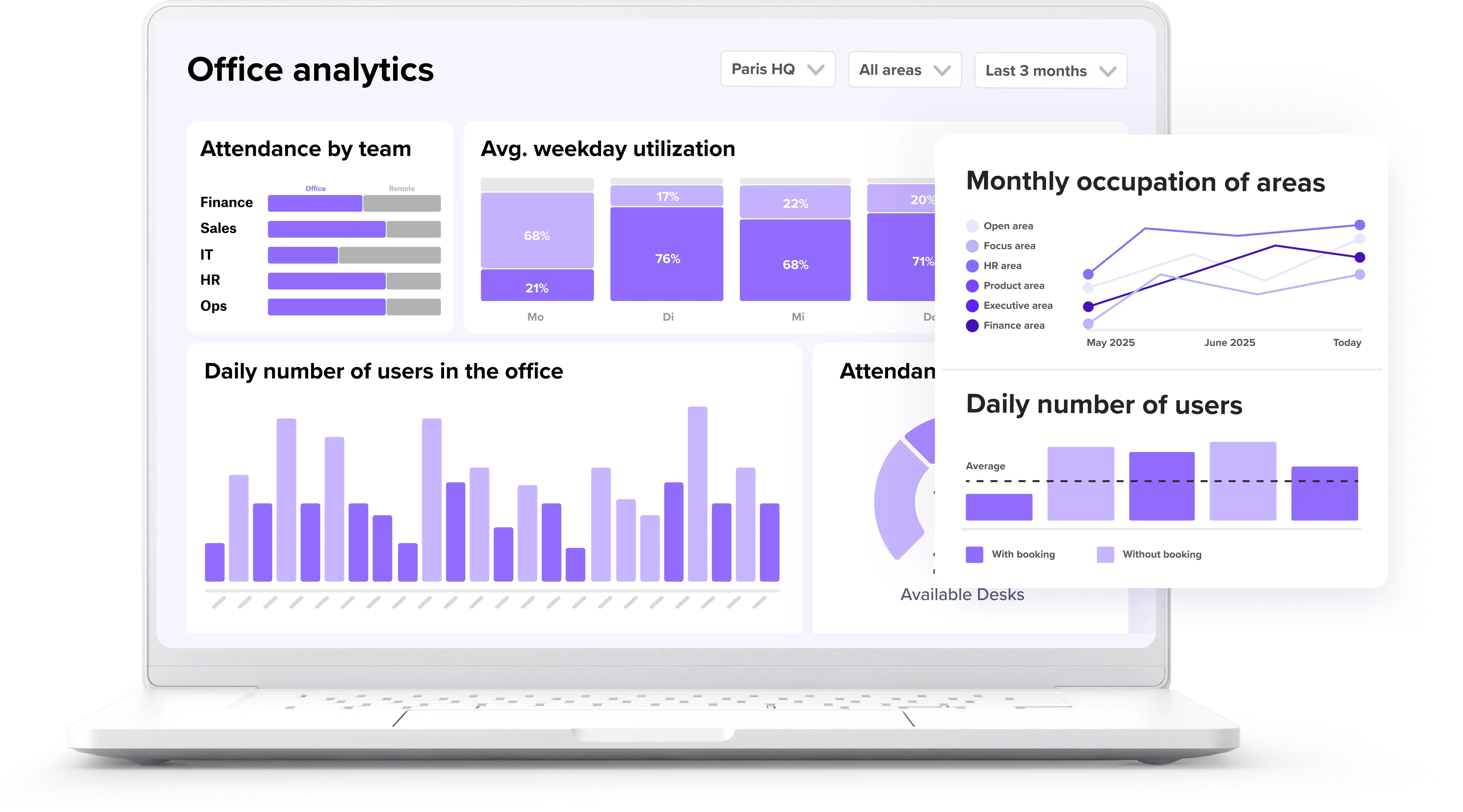
Hybrid work has fundamentally changed how much office space companies need and how they use it. Average office utilization has stabilized at around 40–53% globally, well below pre-pandemic norms, creating both an opportunity and a risk for companies that haven't adjusted their portfolios.
Space and real estate data:
- Global office building utilization reached 53% in 2025, up from 38% in 2024, according to CBRE
- Average office utilization in Q2 and Q3 2025 was 43%, with peak months reaching 46%
- North America has the lowest regional utilization at 48%; Latin America leads at 60%, per JLL's 2025 benchmarking report
- 55% of organizations actively cut real estate footprints in 2025, per JLL's Global Occupancy Planning Benchmarking Report
- 57% of CRE teams expect portfolio contraction over the next 3 years, up from 48% last year
- 67% cite "less space needed due to hybrid work" as the primary driver for footprint reduction
- Companies shifting to hybrid can save 10–50% in space costs by reducing their real estate footprint
- 90% of organizations track utilization data with badge swipe systems; 49% use reservation systems. But only 7% rate their data quality as excellent, per JLL
- 68% of CRE leaders name "improving space data accuracy" as their primary goal for 2025
- Peak days (Tuesday–Thursday) now hit 80–90% utilization in many offices, creating real capacity pressure
- Tuesday sees the highest attendance at 73% of companies; far ahead of Wednesday (23%) and Thursday (3%)
What this tells you: Most organizations pay for more space than they use. Average occupancy running at 40–53% means a significant portion of every real estate budget funds empty desks, dark floors, and unused meeting rooms. The companies who act on this don't just cut costs. They reinvest in spaces that are worth coming to, which improves the hybrid experience and attendance. The companies who don't act are essentially subsidizing empty real estate. Room booking software and real-time occupancy data are the starting point for closing that gap.
The catch: 90% of organizations track utilization, but only 7% trust their data. That gap matters. Decisions made on badge-swipe data alone miss actual usage. Tools like desk booking software and workplace analytics platforms close this gap by tracking check-ins and real space usage rather than just booking intent.
What do collaboration and communication data show about hybrid teams?
Hybrid work supports collaboration when it's designed intentionally, but it creates measurable risks when it isn't. The biggest risk isn't lost productivity. It's that people stop running into each other.
An analysis of 122 billion email interactions and 2.3 billion Microsoft Teams meeting interactions found that close-network interactions increased during remote work, while cross-team connections with distant networks declined. Over time, that erodes the informal relationships that drive innovation and mentorship.
More recent collaboration findings:
- Among German hybrid companies tracked by deskbird's Desk Sharing Index 2025, transparent team coordination and digital planning tools were the top recommendation for improving hybrid collaboration. Companies without them showed lower and less predictable office attendance patterns
- According to Microsoft's 2025 Work Trend Index, employees are interrupted an average of 275 times per day in hybrid environments
- 85% of workers say good technology is a top factor in their work life, and the majority say their companies still need to improve the tools that support hybrid collaboration, per Owl Labs 2025
- Collaboration space utilization reached 46% globally in Q2–Q3 2025, up 11 points year-over-year, outpacing individual workpoint usage at 43%
- Meeting room global average utilization is just 30%, and rooms are often occupied at well below their listed capacity
- Organizations focused on purpose rather than policy, combining clear in-office days with redesigned collaborative spaces, are seeing the strongest in-person attendance recovery
- Hybrid workers report the strongest overall sense of inclusion compared to both fully remote and fully in-office workers
What this tells you: Collaboration in hybrid work doesn't fail because people are remote. It fails because collaboration is often unplanned. The offices that work best in hybrid environments are those designed for specific kinds of work: rooms for focused co-working, spaces for spontaneous connection, and clear policies about when teams are expected together. Attendance for attendance's sake doesn't solve this. Workforce attendance data and meeting room booking do.
Does hybrid work differ by industry or role?
Hybrid adoption varies significantly by sector. Knowledge-intensive, desk-based industries have the highest rates; physical, operational, and service roles have the lowest.
[Table1]
Source: Robert Half, 2026 Demand for Skilled Talent report
Other industry-specific data points:
- Knowledge-intensive sectors including HR, legal, and technology have the highest hybrid and remote adoption rates, with management and professional roles recording a 37.9% telework rate in Q1 2024, per the U.S. Bureau of Labor Statistics
- Less than 18.2% of U.S. federal government employees worked remotely in April 2025, down from 31.3% a year earlier, per the U.S. Bureau of Labor Statistics
- Jobs requiring significant physical strength had just a 3.2% telework rate in Q1 2024, per the U.S. Bureau of Labor Statistics
- Tech sector breakdown in 2025: 47% fully remote, 45% hybrid, 9% fully on-site
- Financial services offices lead all sectors in utilization at 63%; legal and professional services follow at 59%
Experience level also shapes access to flexibility. Robert Half data shows that senior-level roles have higher access to hybrid arrangements (20% of new senior postings) compared to entry-level roles (13%).
Company size interacts with geography in ways that aren't obvious. deskbird's European Desk Sharing Index found that in Germany and the UK, smaller companies have higher desk utilization than large ones (Germany: small 38% vs large 30%; UK: small 38% vs large 28%). In Austria and France, the pattern reverses: larger companies use desks more heavily (Austria: large 52% vs small 40%; France: large 46.6% vs small 35%). Structured hybrid policies at larger enterprises in those markets appear to drive higher and more consistent attendance.
What this tells you: The hybrid debate often assumes a one-size-fits-all dynamic, but the reality is sector-specific. A company building its workplace strategy by reading headlines about Amazon or Goldman Sachs is making a mistake if it operates in technology, professional services, or HR. The mandate that makes sense for a trading floor does not make sense for a software engineering team.
What are the biggest challenges of hybrid work?
What problems do hybrid teams commonly face?
The most common hybrid work challenges are coordination complexity, fairness concerns around visibility, manager skill gaps, and the erosion of informal relationships. None of these make hybrid unworkable, but they do make it harder to manage than a full-time office without putting some real structure behind it.
Key challenge data:
- 50% of employees globally are looking for opportunities or actively seeking a new job, according to Gallup's 2025 State of the Global Workplace, a signal of widespread disengagement that hybrid alone doesn't solve
- Global employee engagement sits at just 21%
- 20% of employees felt lonely "a lot of the previous day" in Gallup's 2025 data; among remote workers, this rises to 25%
- 50% of U.S. workers report moderate to severe burnout, depression, or anxiety in 2025
- Only 13% of employees say they told their manager their mental health was suffering due to work demands
- Gallup found hybrid work models work best when teams, not individuals, determine schedules, but employees with self-determined schedules are more likely to report burnout and work-life imbalance
- 60% of managers say reduced visibility in hybrid settings makes performance reviews more challenging
- In German hybrid offices, deskbird's Desk Sharing Index 2026 found average desk utilization at just 31%, with peak utilization of 36% on Tuesdays and Wednesdays and only 19% on Fridays. At least two thirds of desk capacity goes unused on any given day. Zurich, Vienna, and Paris average slightly higher at 36%
- Despite being the weakest day, Friday was the fastest-growing office day across German hybrid companies in 2024/25, up 8% year-over-year according to deskbird's Desk Sharing Index 2025
- "Coffee badging" (checking in briefly to appear in-office while doing minimal work there) has emerged as a visible sign of disconnect between attendance policy and employee buy-in
What this tells you: The biggest threat to hybrid work isn't productivity loss. It's disengagement and isolation. Gallup's finding that engagement sits at 21% globally is a structural problem that transcends work location. It gets worse when hybrid is managed passively: no clear norms, no defined in-office purpose, and no visibility into who is actually present. Teams that define their own schedules collectively, rather than each person choosing independently, tend to see better outcomes on both fairness and engagement. Our hybrid work guide covers how to set those norms in practice.

How do return-to-office mandates affect employee behavior?
Do RTO mandates actually bring people back to the office?
RTO mandates have increased formal in-office requirements significantly, but behavioral compliance is lower than policy compliance. Required in-office time rose 12% between Q1 2024 and Q3 2025, yet actual office attendance grew by only 1–3% in the same period.
The mandate response data:
- 34% of companies have implemented badge tracking and attendance monitoring
- 28% of companies now tie office attendance to performance reviews or promotion eligibility
- 47% of companies requiring a five-day office schedule plan to terminate or discipline non-compliant employees
- Where a full-time office mandate exists, JLL data reports 82% compliance; for 1–2 days per week requirements, compliance reaches 95%
- Companies with strict RTO policies experienced 13% higher turnover than those with flexible models
- Research from University of Pittsburgh on 12 million Glassdoor reviews found that full-time office mandates in 2024 triggered sharp drops in satisfaction and spikes in attrition, particularly among senior and female talent
- Remote workers' job market optimism declined by 5 points in 2025; fully on-site remote-capable workers saw a 14-point drop; hybrid workers' optimism was flat
What this tells you: The enforcement gap between RTO policy and actual attendance is one of the most telling data points in this space. Companies can write a policy, but changing behavior requires more: purpose-built spaces, team coordination, and a compelling reason to commute. The companies seeing the highest voluntary attendance aren't the ones with strict mandates. They're the ones that have designed offices people want to use.
How is hybrid work different across regions?
Hybrid adoption and culture vary meaningfully by region, shaped by commute infrastructure, labor laws, cultural norms, and industry mix.
Regional snapshot:
- Europe: Over 60% of European companies report average office attendance of 41–80%, up more than 10 percentage points year-over-year. Eurofound research found that in 7 of 10 European organizations studied, hybrid models actually predated the pandemic. Covid-19 accelerated adoption, not invented it. deskbird's European Desk Sharing Index found that Zurich had the highest attendance of any city studied, never falling below 60%, with Tuesday at 99% and Wednesday at 97%. Vienna averaged 76% and Paris 74%. deskbird's Desk Sharing Index 2026 confirms the same hierarchy holds today: Zurich averages 1.58 office days per week and Vienna 1.56, while Germany trails at just 1.31
- UK: Around 28% of UK employees work in a hybrid setup, with 16% fully remote. The CIPD's 2025 Flexible and Hybrid Working report, based on a survey of 2,050 HR professionals, found that 74% of UK organisations have hybrid working in place, and 65% require employees to be in the workplace a minimum number of days per week. Wednesday is the most popular UK office day at 77% attendance, per VM O2 Business Mobility Index data. A 2025 report found only 42% of UK employees say they would comply with rigid RTO demands
- North America: Hybrid workers now spend approximately 46% of their workweek on-site (around 2.3 days), up from 42% in 2022. North America has the lowest regional office utilization at 48%, per JLL
- APAC: Higher remote work adoption overall, but offices are hitting 80–90% utilization on core days (Tuesday–Thursday) in many markets
What this tells you: A hybrid policy that works in Amsterdam may not work in Atlanta. European companies tend to have more formal labor agreements and cultural precedents for flexibility; APAC markets often see higher physical attendance. Workplace leaders managing multi-region teams need regional benchmarks, not global averages.
What does the future of hybrid work look like?
Most organizations have settled on a hybrid model and stopped debating it. The conversation has shifted from "should we do hybrid?" to "how do we actually run it well?" and the data is starting to answer that question too.
Forward-looking data:
- 73% of companies say they will not increase or decrease remote work policies in the next 12 months
- Only 12% of hybrid companies plan to mandate everyone back to the office full-time
- By 2027, 73% of organizations expect people-to-desk ratios greater than 1.5:1, meaning more employees than desks, driving demand for booking systems and space analytics
- The majority of hybrid workers now come in 3 days (39%) or 4 days (34%) per week, both up from 2024
- ~80% of employees are now using or experimenting with AI at work
- Microsoft's 2025 Work Trend Index found that 82% of business leaders expect AI agents to expand workforce capacity within 18 months
- Eurofound's 2025 research shows hybrid work is becoming formalized through policy, negotiated with worker representatives and underpinned by digital infrastructure. This marks a shift from informal team-level decisions to institutional commitment
- Gallup's research confirms the model works best when teams collectively set schedules rather than leaving it to individual discretion
What this tells you: Stability isn't stagnation. The policies are largely set: 73% of companies aren't planning to change them. What's still unresolved is the operational layer: how do you track real usage rather than booking intent, how do you design an office for Tuesday peaks rather than Monday averages, and how do you give teams the coordination tools to make shared days worth showing up for. That's where the gap between good hybrid and mediocre hybrid actually lives.
What do these hybrid work data points mean for workplace leaders?
Every section in this guide points to the same gap: hybrid is now the default model, but most organizations are still managing it with tools, habits, and assumptions built for a full-time office world.
3 things to address first:
1. Fix the data foundation. Only 7% of organizations rate their space data quality as excellent, despite 90% tracking some form of utilization. Badge swipe data tells you people entered a building. It doesn't tell you which desks or rooms they used, when they no-showed, or where capacity is wasted. Real-time workplace analytics linked to booking and check-in data close this gap. With accurate data, facilities teams can right-size leases, justify real estate decisions to CFOs, and stop guessing.
2. Design for peak days, not average days. The shift toward Tuesday–Thursday concentration means your office needs to handle 80–90% utilization on core days and 20–30% on Fridays. Static desk assignments don't work in this environment. Desk booking software makes this manageable: employees can plan around colleagues, managers get advance visibility, and no-shows don't block space.
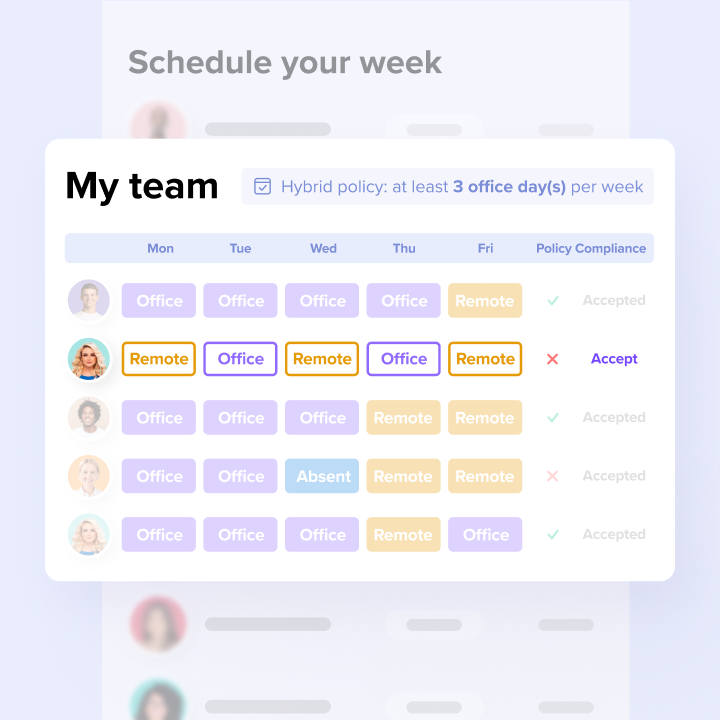
3. Make the office worth attending. The companies seeing the strongest voluntary attendance aren't mandating it. They're investing in collaboration spaces, reducing friction through better technology, and creating a positive workplace experience. Employees who have a positive view of their office are far more likely to comply with hybrid policies, even when they've been set collaboratively rather than imposed from above.
deskbird's workplace management platform is built around exactly these 3 needs: high-adoption booking, real utilization data (not just intent), and a colleague visibility layer that turns office days from habit into deliberate choice. Over 90% of employees across 500+ companies use it daily, which means the data it generates is accurate enough to make real decisions.
Conclusion
Hybrid work is settled. The data points in the same direction: hybrid is what most knowledge workers prefer, it doesn't hurt productivity, and it significantly improves retention. Return-to-office mandates have tightened policies but not behavior.
The organizations that will get the most from hybrid work are the ones who stop debating whether it works and start building the infrastructure to run it well. That means trustworthy space data, intentional office design, and scheduling tools that reduce coordination friction.
Want to see what hybrid management looks like in practice? Book a demo with deskbird and see how over 10,000 workplace teams make data-driven decisions about their offices every day.

Frequently Asked Questions
What percentage of workers are hybrid?
Approximately 52% of remote-capable U.S. employees work in a hybrid arrangement as of 2025, according to Gallup. Globally, around 67% of organizations now operate some form of hybrid work model. Among knowledge workers specifically, hybrid has become the clear majority position.
Does hybrid work reduce productivity?
No. A randomized controlled trial of over 1,600 workers published in Nature by Stanford economist Nicholas Bloom found that employees who work from home 2 days per week are just as productive and equally likely to be promoted as fully office-based peers. Multiple large-scale surveys back this up, with 90% of hybrid employees reporting equal or higher productivity than when in-office full-time.
What are the most popular office days for hybrid workers?
Tuesday and Wednesday dominate. deskbird's Desk Sharing Index 2026, based on over 30,000 users across 8 German cities, found that these two days account for 47.7% of all office schedulings. Friday has fallen to just 11.3%. The pattern holds internationally: in Zurich, Vienna, and Paris, Tuesday peaks at 99% and Wednesday at 97%, per deskbird's European Desk Sharing Index.
How many desks go unused in a typical hybrid office?
Most. deskbird's Desk Sharing Index 2026 found average desk utilization at just 31% across German hybrid companies, meaning roughly 2 in 3 desks sit empty on any given day. Peak utilization hits 36% on Tuesdays and Wednesdays, dropping to 19% on Fridays. CBRE's global data puts overall office building utilization at 53% for 2025, still well below pre-pandemic norms.
See how deskbird makes every commute count
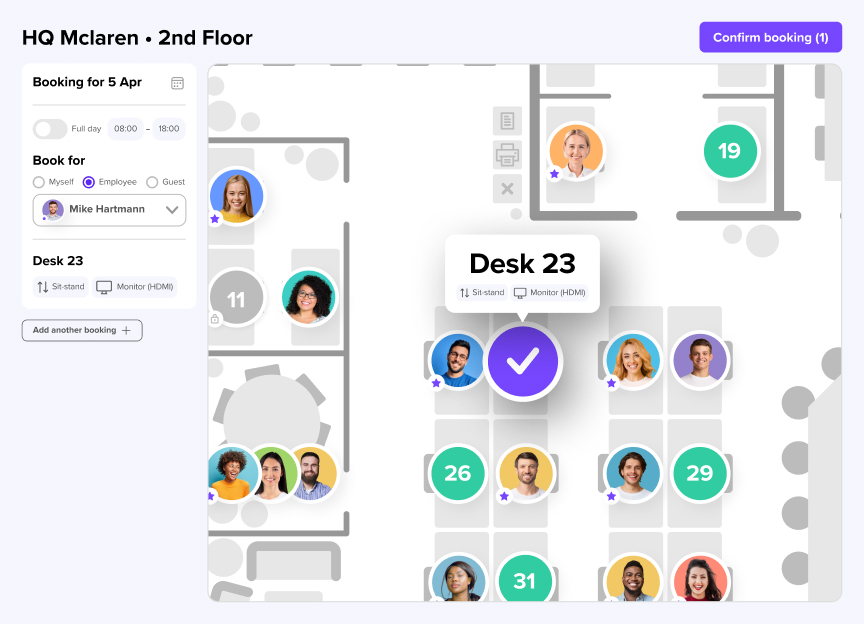
- Show employees who's in before they commit to the commute
- Book desks and parking in one click, no back-and-forth needed
- Get space utilization insights that fuel efficient real estate decisions